
Natalia’s Lafourcade’s “Pajarito Colibrí” was rendered with very plausible spatiality and a lot of air around instruments that at the same had very natural, lifelike presentation. It is also acoustic music and music with real instruments that confirmed the Moon’s proficiency not only in being neutral and transparent, but also for being sensitive to subtle tonality, timbre changes. This is another hallmark of the 791 sonic presentation – its ability to sound both textured and being sensitive to even subtle changes in tonality. This is another thing that proves its gift to connect lush, abundant soundscapes with sheer transparency.
Line-level pre-amp and phono stage
Let’s not forget that 791 is, apart from being a network streamer and a digital to analogue converter, also a preamplifier with a built-in phono stage. So, let’s consider the line-level capabilities first. If anyone thinks that this part is added for the sake of being only another functionality that could become an additional selling point – he should restate his assumptions. The preamplifier in the 791 is not only extremely quiet, but is also sonically (almost – let me get back to this just in a second) invisible. I did connect some other – very various, ranging from very cheap and to hi-end, sources. And what struck me were actually two things. Every time I listened to that connected device’s sound character, not the Moons. And there were cases where it was better to switch off the volume control in that gear, route it though Moon 791 and use its MVOL3 adjustment.
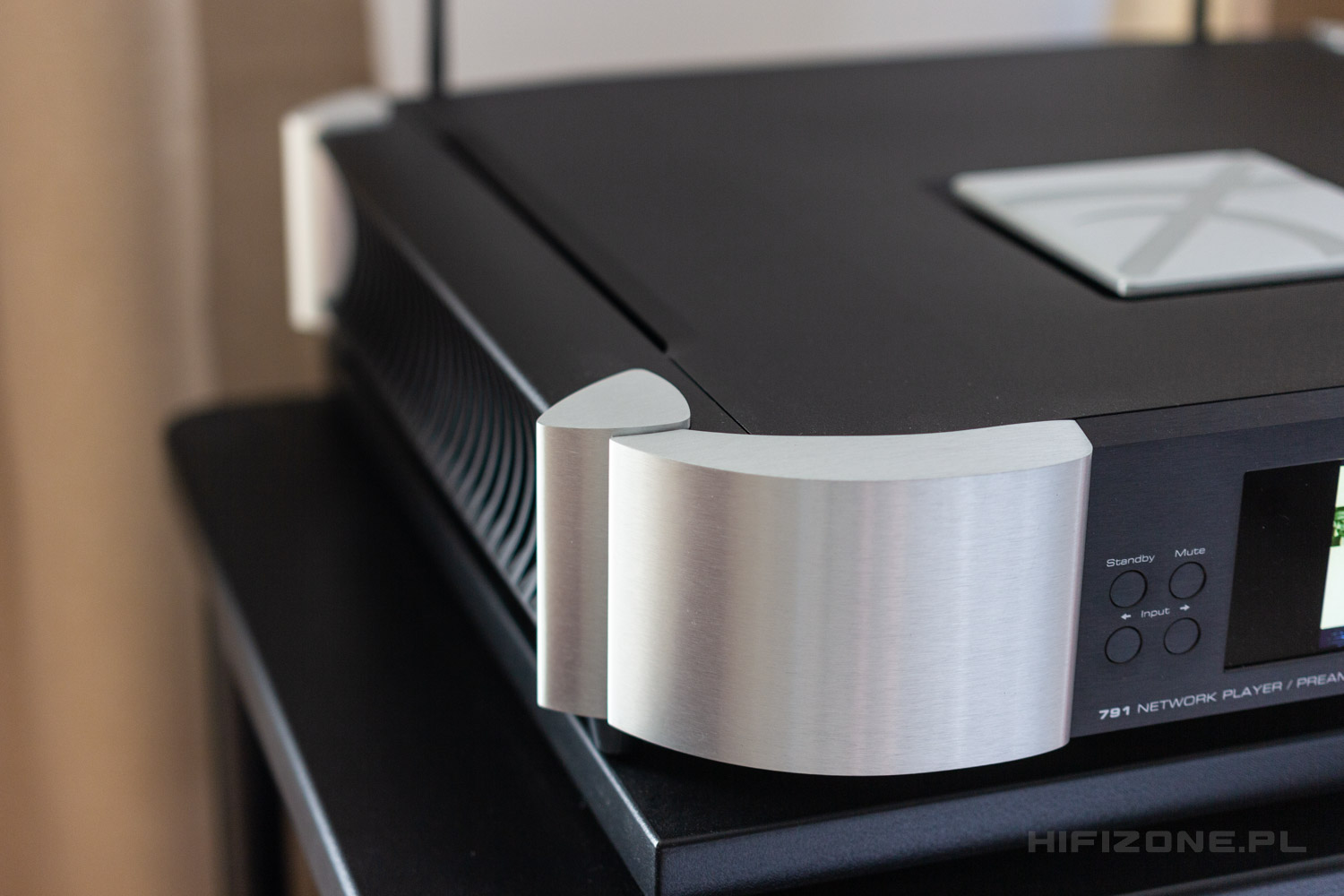
In other words, the preamp capabilities are, well, serious. And I have a very prevalent feeling that listeners who will in reality need a higher resolution preamp would decide to go separates anyway. And they may not get any significant gains in this area unless they opt for some really esoteric gear. What is also important here is the fact that the total sonic signature of the preamp, which is neutral, transparent yet not dried-out naturally helps it to stay as invisible as it can. And the fact that if sports a really good, well thought-out volume control is, obviously, another virtue that should be considered.
Also, the phono stage in the 791 is really good sound-wise. While I feel it is not on the level of the line preamplifier – which is extraordinarily good – it is clearly better than you could expect from an “integrated” unit. I would say that it’s on par with the outboard phono stages that cost around 3K Euro (or USD, depending where you are). The phono section is also really elaborate in the terms of settings. Because you can select not only impedance for the Moving Magnet cartridges, capacitance for Moving Coil ones, but also equalization curve (RIAA or IEC) and gain.
Moon 791 with the 761 power amplifier
This is where things get even more interesting. And let me flip here the normal chronology here and start with a conclusion that was inevitable after a few days of listening to the combination of 791 and 761. And I mean listening to really wide material, from experimental and electronic music, trough pop, rock, classic and ending with the usual suspects that are often guests on my playlists. In a nutshell: if somebody who considers the 791 is also in need of a new amplification, then the 761 should be at the very top of the list. Even those who prefer the syroupy sound of some big valve power amplifiers should audition the 761. Because even if they decide to go another route meeting with the 761 will be very informative – and this is to say the least.
Prior to this review I listened to two Moon’s integrated amplifiers – the 600i V2 first, and a bit later to the new entry-level 250i V2. While both of them being very good for what they were, I do strongly feel that in regards to the 761 – the whole context changes. Thing is that the new Canadian power amp is on a different level altogether. The first thing that I noticed was the unforced transparency and the spatiality of the sound. It was apparent not only on albums like “Convergence” by Malia and Boris Blank but also revealed itself on completely unexpected occasions when listening at background levels.
Thing with the 761 is not only the transparency and uncanny sonic realism that it is capable of conveying. What is more interesting here is that it does not sound dry nor with too much saturation at all. I believe that it just goes with the Moons attitude of providing as clean amplification as – given the price point and technological possibilities – possible. What I also mean by that is the resulting fact that such character of the 761 will allow for adjusting the end result with speakers. Because the whole 791 and 761 combination will be transparent and neutral in the first place. The rest will be left to the choice of speakers, room (and its treatment) – and many other things that I won’t mention here. The combination of 791 with the power amplifier from the same stable has the tonality set to neutral and, and I believe that this is not a mere coincidence. But rather a conscious decision that, in turn, allows the lucky owner of both to have as wide selection of possible sonic outcomes as possible. And if transparency is your thing – then you will be really at home with the 761.
Moon 791 – conclusion and a few important closing remarks
Let me be blatantly honest here by stating something that could possibly stir the whole audiophile pot for many. Moon 791 is a perfect example of direction where the modern hi-end audio should be going. It’s not only about the sound, which anyway in this particular case is simply stellar. Its more about the fact that the 791 is both complete as a source component when looking at its network streamer and DAC capabilities, and also its innate strength lies in the virtue that it will function as a centre of a truly hi-end system without all the fuss usually associated with.

Summing up – it’s not necessarily cheap, but you get what you pay for. It’s a top-flight component that definitely warrants an Editor’s Choice award here.
As for the 791 and 761 combination – it’s equally impressive. The power amp that I got with the 791 is just transparent and neutral. Nothing more and nothing less. But what’s interesting here is the fact that the sonic signatures of both units, while similar in general, also seem to complement each other really well. Why I mean by that is that while the 791 never sounds technical nor cold the 761 adds to its lush and clean sound that additional bit of accuracy. Which in turn allows fine-tuning of the final outcome. Because Moon, with the 761, gives the listener a choice – whether will he go for that last bit of transparency, or if he want to go a bit to the side with the choice of other components, mainly the speakers. While the star of the show is definitely the 791, the whole system also warrants an Editor Choice award and the 761 can be wholeheartedly recommended too.
Adam Kiryszewski

Pricing: Moon 791 – 16000 USD, Moon 761 – 14000 USD
Manufacturer website: https://simaudio.com/en/
Product website: https://simaudio.com/en/product-category/north-collection/