
This power amplifier is also balanced up to the power stages, which is how most of those units are made topology-wise. It becomes fully balanced – with floating outputs (so negative output terminal is also active, instead being connected to the ground) – in a bridged mode.
There’s also a DC/AC switch which may be usable when we connect the 761 to an older preamplifier or source that may have some small DC content on its outputs (which would be amplified to much higher levels that could cause some problems on the speaker side).
As with the 791, the 761 uses a lot of Moon’s own in-house developed technology. Take the MDCA for example which stands for MOON Distortion Cancelling Amplifier. This is an intricate solution with advanced circuitry that does an error correction in real-time. The whole circuit is also devoid of any global nor local negative feedback. And Moon uses custom output transistors which are made to very tight tolerances and matched ever further at the factory to attain that last bit of sonic performance.
Obviously, there is a lot to talk about regarding the 761 and the Moon amplification in general. Therefore we will soon provide a follow-up to this review with a special insight into Canadian company’s technology that is widely used in its new North Collection. So, for that – stay tuned. And now – it’s time to get to the matter that everyone has been waiting for.
Moon 791 – the sound.
First things first, let me be perfectly clear about something. The Moon 791 is, obviously, far from being affordable. But just after listening a few well-known tracks on a properly warmed-up system – it’s actually easy to notice its sonic prowess. In other words, it takes just a short while to realize that this particular component actually belongs to the highest ranks and is fully worth of a hi-end designation. This is one thing. The other is the fact that this feeling not only lasts, but the longer you listen to 791, the more you appreciate its sound. Moreover, just for the sake of clarity – as I mentioned, I listened to Moon 791 both as a standalone unit and in a combination with the 761 power amplifier. More comments and conclusions from listening sessions to the whole combination you’ll find later on, so if anyone is directly interested in the 761 only – feel free to jump directly to that following section.
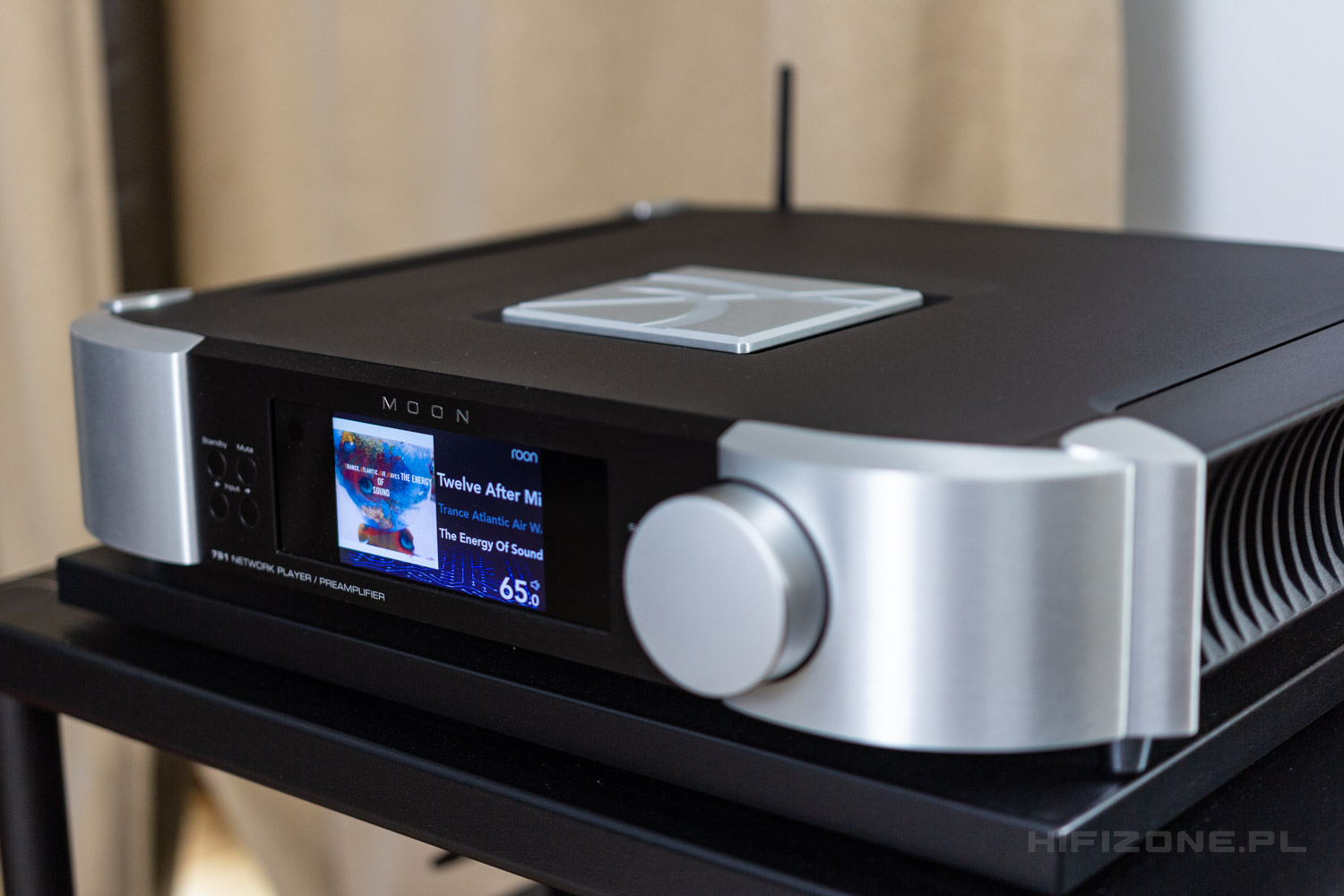
So, how does the Moon 791 sound? If I had to describe it in one sentence it would be: organic, enveloping and at the same time precise and unrestrained. On Daft Punk’s and Giorgio Moroder collaboration track “Giorgio by Moroder” (Daft Punk “Random Access Memories” album) you can instantly hear its rich tonality that goes together with serious dynamic clout. Another thing also becomes apparent on the whole “Random Access Memories” album: while the sound is lush and filled with layered and three-dimensional soundscapes, it also boasts that natural kind of precision that is rarely found, yet very sought-for by many experienced listeners. You see, Moon 791 doesn’t draw attention to its resolving capabilities, you never have a feeling that its overly analytical, yet all the resolution is here. It just doesn’t manifest itself in any crude manner, not it’s not for the sake of showing-off.
This is that kind of precision that always sounds relaxed, yet never ceases to amaze when the repertoire calls for it. In other words, Moon has that innate ability to shine a light without sounding over-exposed. Let me put some analogy here using the comparison to LED lamp bulbs. Some of them are flickering due to their PWM regulators, but while you won’t notice this – the light won’t be one hundred percent natural. Somehow you will feel that there’s something off with it. There are some less common types that have almost flat regulation, without flickering. This is the case with the 791 – the light here is natural. It doesn’t have to be at full brightness to show everything. And I am also talking about the general tonal balance and timbre here. The adjective that I used two sentences before – natural – comes to mind first.
On Nils Frahm “Says” there was a very specific vibe of the recording apparent from the first notes of it. The 791 seduces from the beginning and draws into the music without any sweat, nor causing any fatigue in the longer run (provided the whole system is of equal capabilities). On the whole Frahm’s “Spaces” album the capability to convey both louder and quieter passages with the same resolving power was also apparent hallmark. And with that, came another – possibly the most important here, considering the whole sonic picture – realization. The Moon 791 while not sounding overly warm, over-saturated or tubey in any way – has almost uncanny ability to convey emotions.
This is something that actually made me wonder for a while led to an interesting finding. The thing is that this talent is often associated with some esoteric single-ended triode amplifiers. And here we have a source component that is entirely solid-state, yet still has that boogie factor which goes along its proficiency in all the technical, objective areas. This is because there’s actually one thing that Moon 791 has in common with some of the breed I described above. It just moves out of the way and lets the music flow. While there’s no device that would act like a hundred percent “wire with gain” apparatus, the imprint that the 791 leaves is both very discreet and practically unnoticeable without some serious comparisons. It may sound warm, but this is the kind of warmth associated by the lack of various distortion mechanisms rather than being over-saturated per se.
That was clearly apparent on the Aimee’s Mann intro song from the Magnolia movie. It begins with the vocal alone which is very precisely rendered in the middle and then accompanying suite of instruments starts its thing. Moon showed that it can sound focused in the intro and then engrossing later on. And all this without even the smallest hint of loosing the composure. It’s not only unbothered by the complexity of the material, it actually keeps its enthusiasm and wide scale even with the most complex music. Be it classical, pop, rock or anything else – it just stays unbaffled.
And then there’s the soundstage that the 791 is able to throw. It’s not the fact that it’s enormous, both considering the with or depth of it. It’s not only that it’s also truly three-dimensional, where you can discern the cues related to the height. It’s more about the fact that its just enveloping by the virtue that it’s natural and engrossing – even considering the sheer size of it. There definitely must be something with the Moon’s implementation of its MDE-2 digital decoding engine. What I mean by that is: while the soundstage that 791 generates is massive and enveloping, it also has two less common traits. It provides see-through, ethereal stereo images while never sounding etched. There’s also none of that artificial, possibly digital glaze that you soon realize is a part of many other digital front-end packages. And I don’t mean the harsh sound per se, but the lack of plasticity and vividness of three-dimensional images that are projected on the soundstage.