
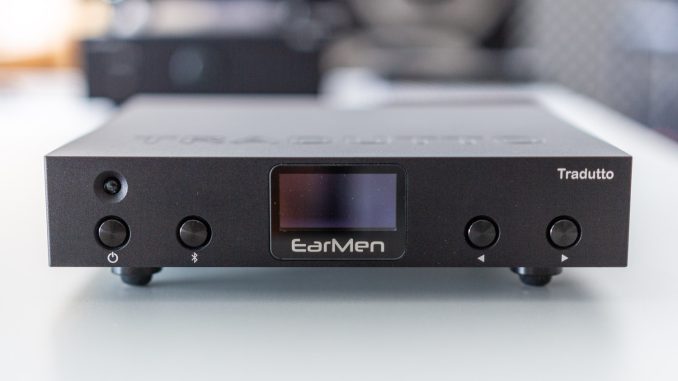
EarMen Tradutto is a digital-to-analogue converter that is a sibling to a recently reviewed balanced headphone amplifier CH-Amp. Both are made by a Serbian company EarMen and – as I already mentioned in the CH-Amp’s review – they are a part of a stack that won the prestigious EISA award for the EISA HEADPHONE SYSTEM 2022-2023. That top-scoring setup also included the Staccato network streamer, but the most frequently seen is the combination of the CH-Amp together with the Tradutto as a source – usually both connected with a 4.4 to 4.4 balanced line connection. All of the aforementioned EarMen units (CH-Amp, Tradutto, Staccato) share the same-width enclosures and are naturally meant to form a complementary combination that can offer both the functionality and the sound – while still being desktop-friendly and functional in everyday use.
It’s also worth mentioning that the recently reviewed CH-Amp turned out be to a first-class performer, thus staying in our reference system for good. Looking closer at the Tradutto DAC, we can see that it’s a smaller, one-box solution (CH-Amp had a dedicated outboard PSU, more on that later). The box size and dimensions are exactly that of the main amplifier unit of the CH-Amp, so in this regards you can see it as the EarMen’s headphone amp sans the PSU. And after closer examination we will also know that Tradutto is also a ESS Sabre based DAC with some interesting twists. For example, you can power it from the included in-wall PSU or connect it to the PSU-3 that comes as a part of CH-Amps’s package. And that’s not everything, there’s more to it.
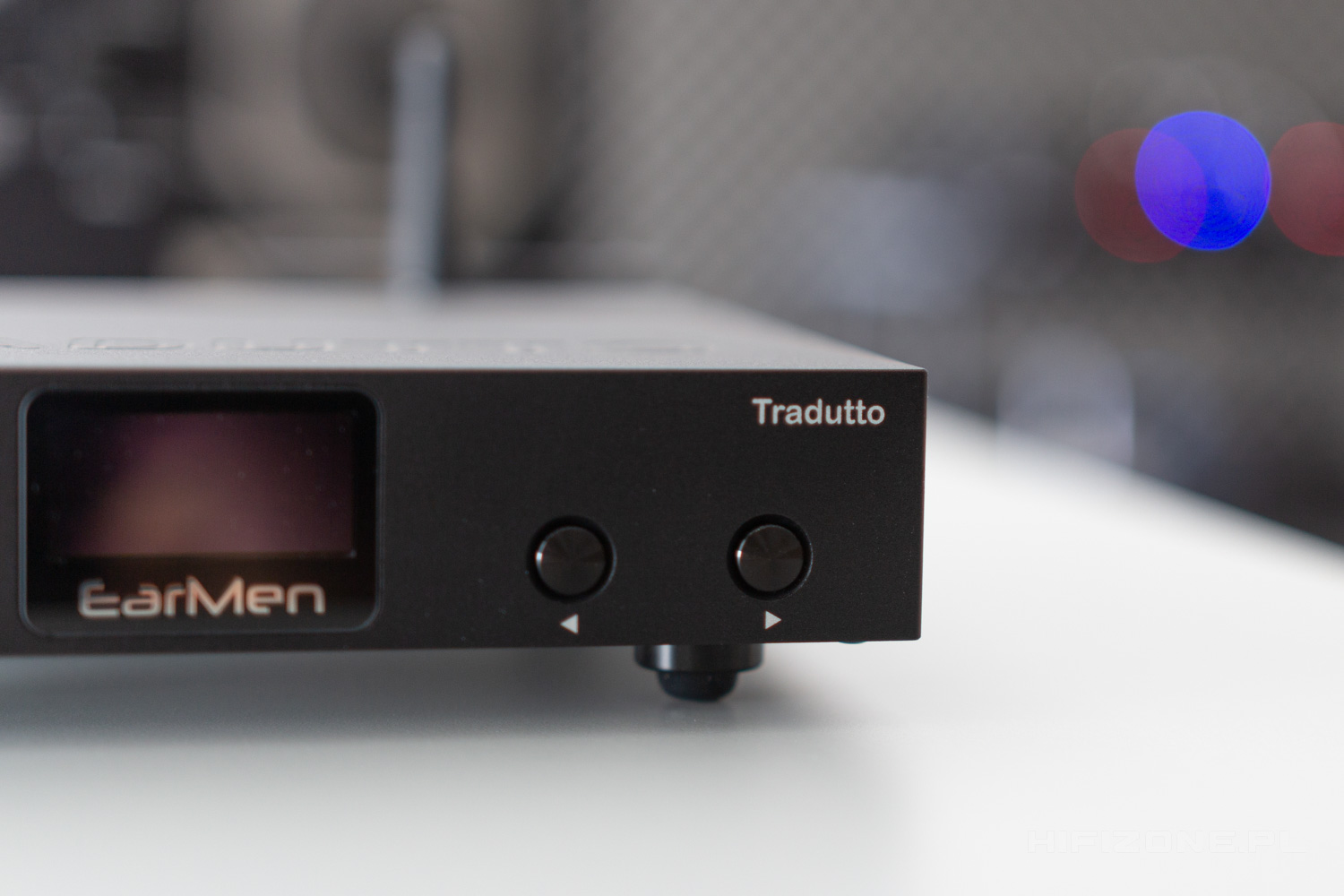
EarMen’s DAC also has a fully balanced architecture, albeit with a 4.4 Pentaconn as an output – which, by the way, corresponds with a 4.4 input in the CH-Amp. Moreover, there’s pretty modern implementation of Bluetooth, sporting the 5.1 reincarnation of it, together with the support for the whole bunch of newer codecs, like aptX-LL and, especially, aptX-HD included. Additionally, we will find the XMOS-based USB input accepting up to PCM 768 KHz and DSD up to DSD512. And the we’ll also find usual suspects in the terms of more legacy digital inputs – S/PDIF and TosLink lurking from the back. They are not that widely used nowadays, but still – may be of importance in some scenarios, especially when connecting a tv or gaming are involved.
EarMen Tradutto now retails around 599 Euro or 499 USD, which naturally places it at an interesting spot. Since it’s definitely not a budget offer anymore, while still without being any kind price extravaganza usually associated with the bigger units. Yet the EarMen markets its DAC with some interesting design traits like gold-plated PCB or careful circuit design around the ESS Sabre chip. And since especially the latter is of the utmost importance, let’s see how it correlates with the Tradutto’s sonic flair. Moreover, because many – most of them ranging from very positive to rave – reviews mostly focus on Tradutto being the first element in the headphone system’s chain, we’ll also check how it compares with the big boys, in the fully-fledged main speaker system. Because, chances are, that it may indeed pack well above its weight.
EarMen Tradutto – design and functionality
Since I described all the things that concern the EarMen desktop system as a whole in the CH-Amp review – let’s focus here on the Tradutto itself. It is a DAC with three digital inputs (USB, S/PDIF and TosLink) and two analogue outputs – single-ended and balanced one. The latter, as I mentioned – uses one 4.4 Pentacon connection, instead of the XLR standard sockets. This is understandable, bearing in mind the small statue of the Tradutto. And, as I also mentioned in the CH-Amp review, more and more companies use the 4.4 connection between devices nowadays – especially when they are intended for desktop usage, thus much smaller than your average-44cm-width component. The volume on both single-ended and balanced outputs is fixed, so no pre-amp here (this duty was delegated with success to the CH-Amp). What we will find however, and what may be a welcome addition for some – is the aforementioned Bluetooth 5.1 with its aptX-HD support. I can imagine some scenarios, where this can be treated a more-convinience-less-quality approach to streaming. Especially when we consider the fact, that many DACs at or near this price point have the Bluetooth functionality implemented.