
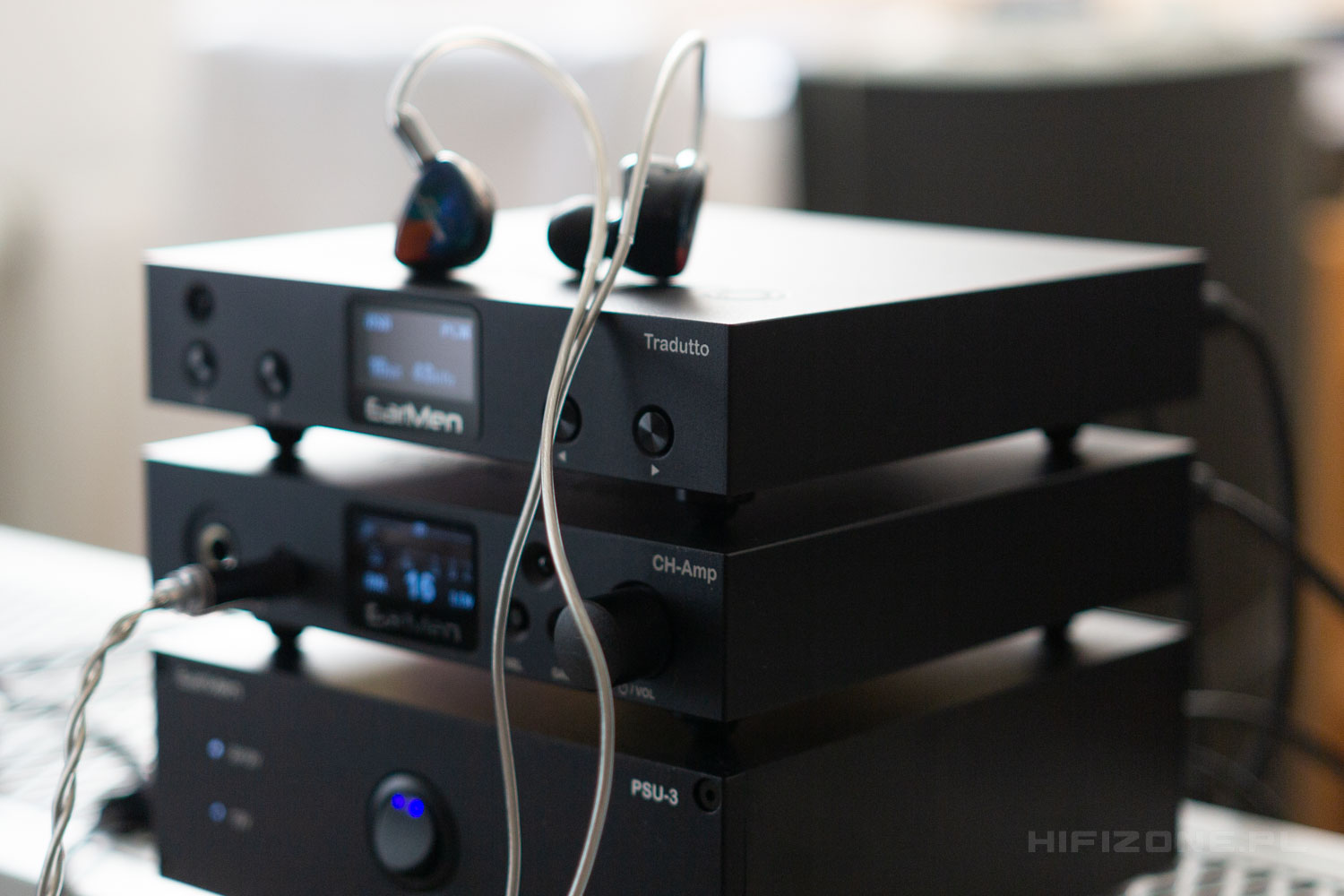
On the front of the unit, we’ll find the display with two buttons on the side, which are responsible for power, Bluetooth pairing and source selection. The display itself is actually very similar to the one found in the CH-Amp: blueish in colour and with just the proper brightness to see what’s actually on it without making the entire room (or more often: a desk) lit at night. The same choice regarding display intensity was made on CH-Amp and the two devices look really good together, so no wonder they are so often paired. As for the – Bluetooth – pairing itself: works as advertised, so no problems nor comments here.
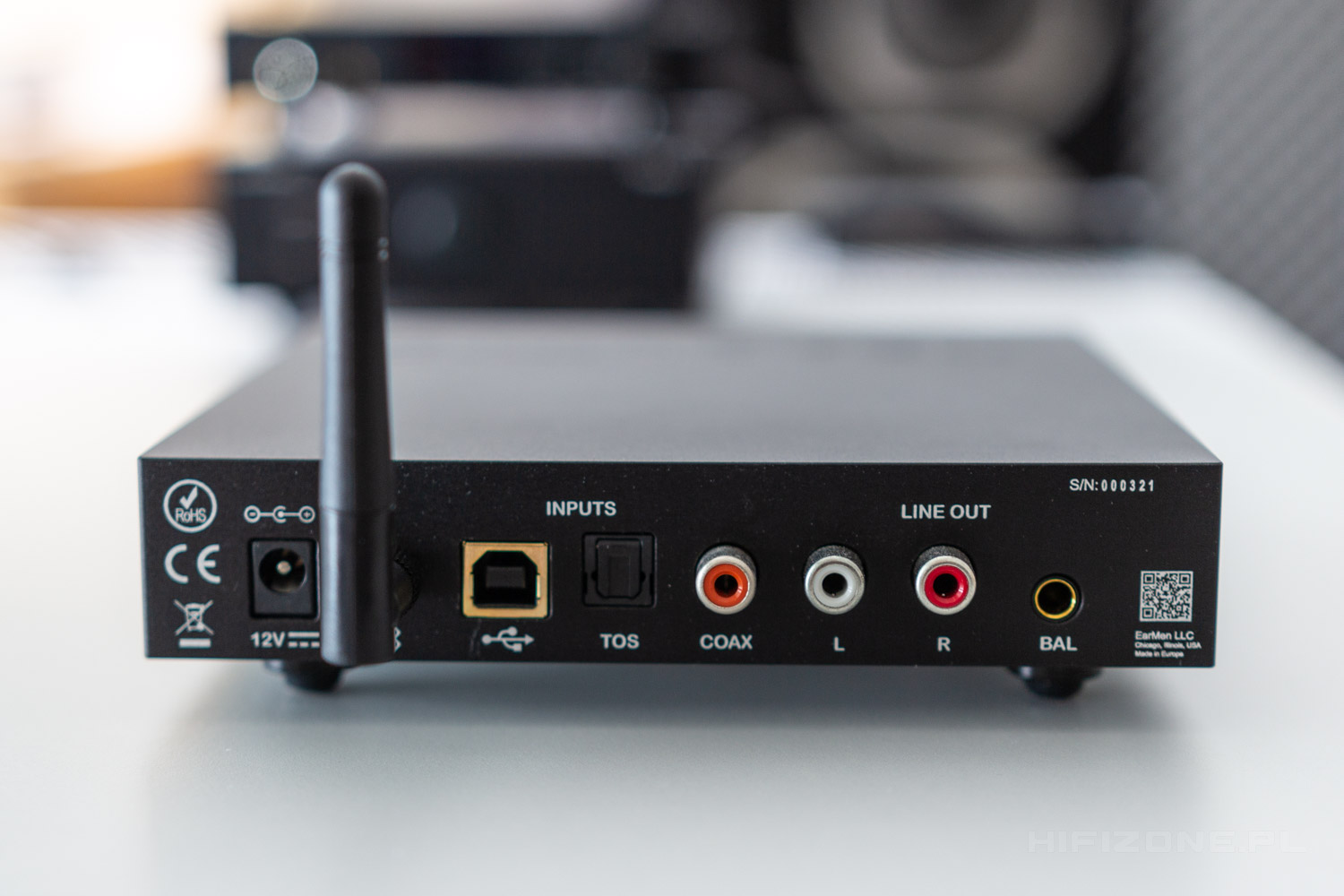
However, what I would like to mention is the fact that if you use the Tradutto alone, chances are you will also use the supplied in-wall power supply. Don’t get me wrong, it’s not that the Tradutto sounds bad with it, far from it – but, as with many DACs, there’s a great improvement that can be made when using a dedicated (in this case a 12V so, after 5V, probably second more popular available) linear power supply. We will get back to this later, since now it’s the high time to delve upon other important (maybe even the most important) thing here: the electronic design and the DAC chip of choice in the EarMen’s Tradutto. These aspects are obviously interconnected and it’s that part of this review, where I’d like to stop for a while and make a small, but really important in the context of Tradutto’s review, excursion. You see, in audio there are some misconceptions, or – for the lack of a better word – a stereotypes. People see that a certain type of a speaker driver or a DAC chip is used and then, based on this fact, they tend to associate one from a few sonic signatures to it.
Obviously, there are many cases, where this may be somehow fitting, but I cannot stress high enough, how crucial is the actual implementation of a certain type of the component to its final sound, or a sonic signature. There was even an old white-paper made by one of the DAC chips manufacturers, that states in percentage the level the sonic impact of the DAC chip itself – and, according to them, it was less than 50%. Nowadays we all know that there are many design factors that contribute to the whole sonic picture: jitter suppression, power supply, I/V stage and many other more or less important factors. I am emphasising this fact on purpose, since – as you will later see – there’s little correlation between the Tradutto’s sonic flair and the stereotype sonic signature associated with the chip at the heart of the Tradutto DAC.
As you might have guessed the Tradutto is based around ESS Technology’s offering, ES9038QM2 to be precise. This one chip is used in a really wide spectrum of devices – ranging from cheaper converters to those that have true hi-end aspirations. It was even used in the Pro-Ject Pro Box RS2 Digital that I reviewed some time ago, which was more than three times as expensive as Tradutto. On the USB side of things, we will find another usual suspect: the XMOS XU216 2000MIPS 16-core variant of the USB Controller. It’s also where all the MQA-relevant (MQA, MQA Core, OFS) decoding takes place.
The most interesting though – are some of the less-than-obvious design choices. Especially those that you won’t easily see, but which may definitely have some, or even more than some, impact on the overall sound performance. Take the gold-plated PCBs for example, which actually sparked my interest a long time before even reviewing the CH-Amp. This is a feature that is not often found even in much pricier gear, let alone in a DAC that costs below the 1K Euro (or USD, depending on your location) mark. And it offers, according to manufacturer, not only a flatter surface more suitable to todays’ newest electronical elements, but also a better electrical performance.
The SS938Q2M chip itself has been – according to the manufacturer – very carefully implemented, with special care taken not only in regards to the measured, objective performance, but also to the actual sound signature that a its application would entail. I would like to quote here Mr. Filip Tot from EarMen, because I believe that he actually may have a point here:
“Much depends on all the components used and the topology of the amplifier. It is important to understand which component in which way affects the measurements and which affects the sound, sometimes these two things are connected, and often they are not because in the end the most important thing is how something sounds. Tube amplifiers, for example, have much more distortion and noise, and they sound incomparably better than digital ones, where the specifications are perfect. For marketing, it’s great to present numbers to people because it’s something we understand best, but in audio technology it’s actually less important than sound quality, and that’s why we focus more on sound quality, not just numbers.”
I will allow myself to come back to this later on, since it vital to connect this to the actual sound of the Tradutto. So let’s now come to the gist of the matter.