
You know, in the more generalized, but also absolute scale of audio related things, there’s that aspect, irrespective of price, whether you can listen to a particular device for hours or not. If, and this is a really big if, at some point its technicalities will make you bored or, even worse, tired. This is where the most striking characteristics of the Tradutto comes into play. To put it from a different perspective, I cannot do anything else, but to agree with Mr. Filip Tot from EarMen – yes, the measurements are important, but it’s the sound that counts. And I would also add to the former statement that it’s the sound in the longer term, or longer run that counts the most. This is also why I don’t actually believe in short, A/B comparisons done in some uncontrolled environments. Sometimes you really have to listen a bit longer to grasp what were the intentions of the people behind a certain gear.
And here, inevitably comes – just another conclusion. EarMen is EarMen, but those are the same people that are behind the Auris Audio. So, they know their stuff and also – they decided put focus on musicality and on attaining the best possible sound as a whole without chasing any particular objective aspects. This is a case in point, where somebody definitely has a idea, a vision of how such a device – in this case, a digital to analogue-converter – should sound. You won’t find fifteen digital filters to select from. But after listening to it, you might actually realize that someone here came to a conclusion that there’s that one particular selection that would – in this case, with this circuit – give the best overall result and just went with it.
Listening to Joel’s Burleson’s (better known as Ki: Theory) “Enjoy the Silence” once again proved that the Tradutto is capable of both resolute and textured delivery, while at the same time devoid of any digitus. Yet it still retained that precision and resolution that is usually associated with the ESS Hyperstream architecture. On the captivating soundtrack of The Social Network composed by Trent Reznor and Atticus Ross, and especially on tracks like “A Familiar Taste” Tradutto served both the scale, the immediacy and – don’t forget that third important ingredient here – space.
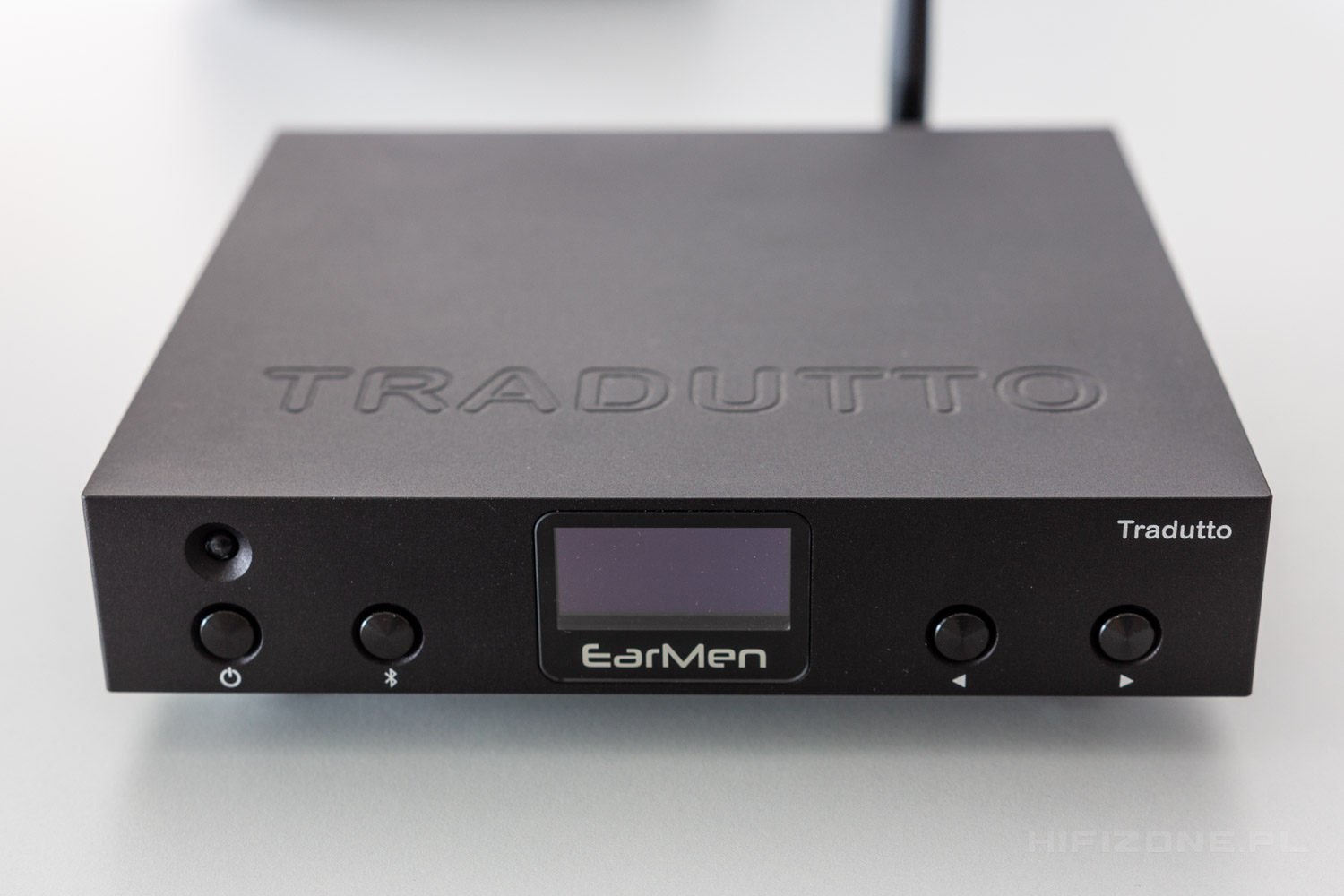
If I had to point out the only gripe that I could have with the Tradutto – it would be that, ironically and perhaps contrary to the common knowledge (which I addressed earlier), it may be to well-balanced sounding for some. You know, there may be listeners that would like more “in your face sound” (not that the Tradutto is veiled in any way), and may lend towards the presentation that, for example, a twice as expensive Chord Qutest can offer. Or maybe want to have one, or two objective, more quantitative aspects of the sound on the higher level – rather than have a balanced whole. And the whole balance is on the rich side, the midbass is quite strong, so – if we take the context of a entire speaker system – it would better mate with speakers that have a linear response in that area that those with bass-reflex port tuned to obtain some significant boost. But tha would be all. So, undoubtedly, time for a conclusion.
EarMen Tradutto – some (possibly) interesting closing remarks
When I first received the entire stack consisting of the CH-Amp, Tradutto and Staccato, the two first of them intended for a review, I thought that one of the devices will be better than the other. Because when you usually have a headphone amplifier and a DAC that goes with it (as a separate box, to be precise) – the chances are that only one will be actually the star of the show. The difference may be ranging from slight to staggering, but it tends to often be there. And now, after listening to Tradutto for more than a few weeks – I must say that this is a very rare situation, and the reasons for it are actually twofold. First and foremost – and this is not widely emphasized, so it goes as first on purpose – this is simply a very good standalone DAC. Second, and this will be more obvious, it is also great as a combination with the CH-Amp.
BUT, don’t save the Tradutto for the headphone system alone. Because, what was remarkable was its capability in the wild, connected to even a larger speaker system. And its clean, slightly warmish, yet still textured and layered presentation will definitely turn some heads. Especially those that may disregard it on the basis that it’s not the nowadays oh-so-popular R2R custom solution. It needn’t to be. More to that, this is by far the best implementation of the ES9038Q2M to date in the terms of sheer musical involvement that I’ve came across and should be treated as a benchmark, or – at least as one of the benchmarks – in the sub-1K USD/Euro category.
In other words – a Best Buy.
Manufacturer: EarMen LLC, Chicago, IL 60601, United States https://earmen.com/
https://earmen.com/
Price: 599 EUR (Incl. VAT – Europe), $499 (excl. VAT – US)