
Just the last thing regarding the design here: I don’t mind the banana plugs here, just be aware that you won’t use speaker cables with spades here. If you need to connect a subwoofer with some high-level inputs – you’ll need to improvise a bit here. And the power switch’s at the back. But that’s all. Really. Time to move on to the gist of the matter.
Schiit Gjallarhorn – the sound
First things first – soon after I connected the Gjallarhorn, I left it on and let it warm up for something like an hour and then decided to do some more critical listening together with making some notes. Interestingly, I listened for longer than an hour and was actually more interested in music itself than doing my job as a reviewer.
Approximately two hours later, and after listening to some of my favourite music – not necessarily from the playlists with the “review” tag – the general conclusion was pretty obvious. This may mean that I will somehow start from the end here, but here you go: if you remove that “10WPC”, and the small form factor from the whole equation – you get a power amp that in the terms of being clean, fluid and having “that something” (more on that later) in its sound is simply beyond its price tag. And by a wide margin. While the Gjallarhorn’s sound is not stereotypically warm nor tube-like, there’s definitely something captivating in its timbre. This one aspect alone is in stark contradiction to its 299 USD price tag.
Let me also point out here that the whole Continuity concept that Schiit brags so much about – undoubtedly seems to work here. The thing with the Gjallarhorn is the more I listened to it, the more I had a feeling that I am listening to a bigger, more heavily biased into Class-A power amplifier (you know, the kind with radiators on each side and so on…) – than something with a size of a cat.
This is also because, looking more objectively, Gjallarhorn doesn’t exhibit – obviously provided that it’s used within its power limits – any problems nor limitations at the frequency extremes. You can feel that this is one of those wide-bandwidth amplifiers that despite modest power ratings don’t play with the midrange alone. And – while we’re at it – that also has that midrange cleanliness and fluidity that often is a trait of a properly done solid-state amps with a wide margin of bandwidth. This was obvious on Bjork’s “Post” album, and especially on the well-know “Hyperballad” song. The amp provided midrange that was present and fluid and yet the sound had the grunt that this track really needs. What’s even more important, the bass notes were properly differentiated, without any softening. And also, without the tampering of the lowest notes, what is sometimes the case with the lower powered or budget amplifiers. The bottom end on “USS Bainbridge” (Soundtrack from the motion picture “Captian Philips”) was not only firm, but it was also properly presented regarding the left-right transitions that are at a certain point apparent on this track.
The only track that I actually felt that there was that 10W limit in the Gjallarhorn’s output was Hans Zimmer’s “Budgie” (another soundtrack, this time from the “Rush” movie). Interestingly, it wasn’t about the bass texture, or speed, or even weight or control – all of these were really good. It was more about the fact that you can’t bend the laws of known physics. In other words, the bigger amps, especially those solid-state ones, may in reality be more willing to move walls. The lower end is here, it’s more that it won’t have that visceral impact that more powerful amplifiers will have.
On the other hand, on “Watkins Glen” (still from the “Rush” OST) Gjallarhorn provided surprising dynamics and didn’t get lost in the more complex structure here. What’s even more important, it retained that see-through sonic composure throughout the entire track without unnecessarily gluing thigs together.
If we change the repertoire a bit – Marian Hill “Differently” was rendered with gusto and enthusiasm. And with a very, very clear overall presentation that was fresh yet saturated. You could feel that the small Schiit had quite a resolution margin here and this was also expressed and felt in the swinging dynamics and general directness of the Marian’s voice.
The other thing really worth emphasizing with the Gjallarhorn is space. The soundstage is layered and surprisingly wide with a palpable depth. This is just another of those Gjallarhorn’s sound traits that is in the contradiction with its relatively small footprint: the amp is generally small, yet the space that it recreates reminds me more of a bigger amplifier. I also feel here that if somebody intends to use this particular Schiit in a desktop environment with far from being perfect acoustics (lot of early reflections for example) and not a particularly holographic source – may never realize the true potential here. The overall capabilities in the areas like timbre, transparency and space are well beyond of what can be expected and, on a level good enough that warrants giving the Gjallarhorn suitable partnering ancillaries.
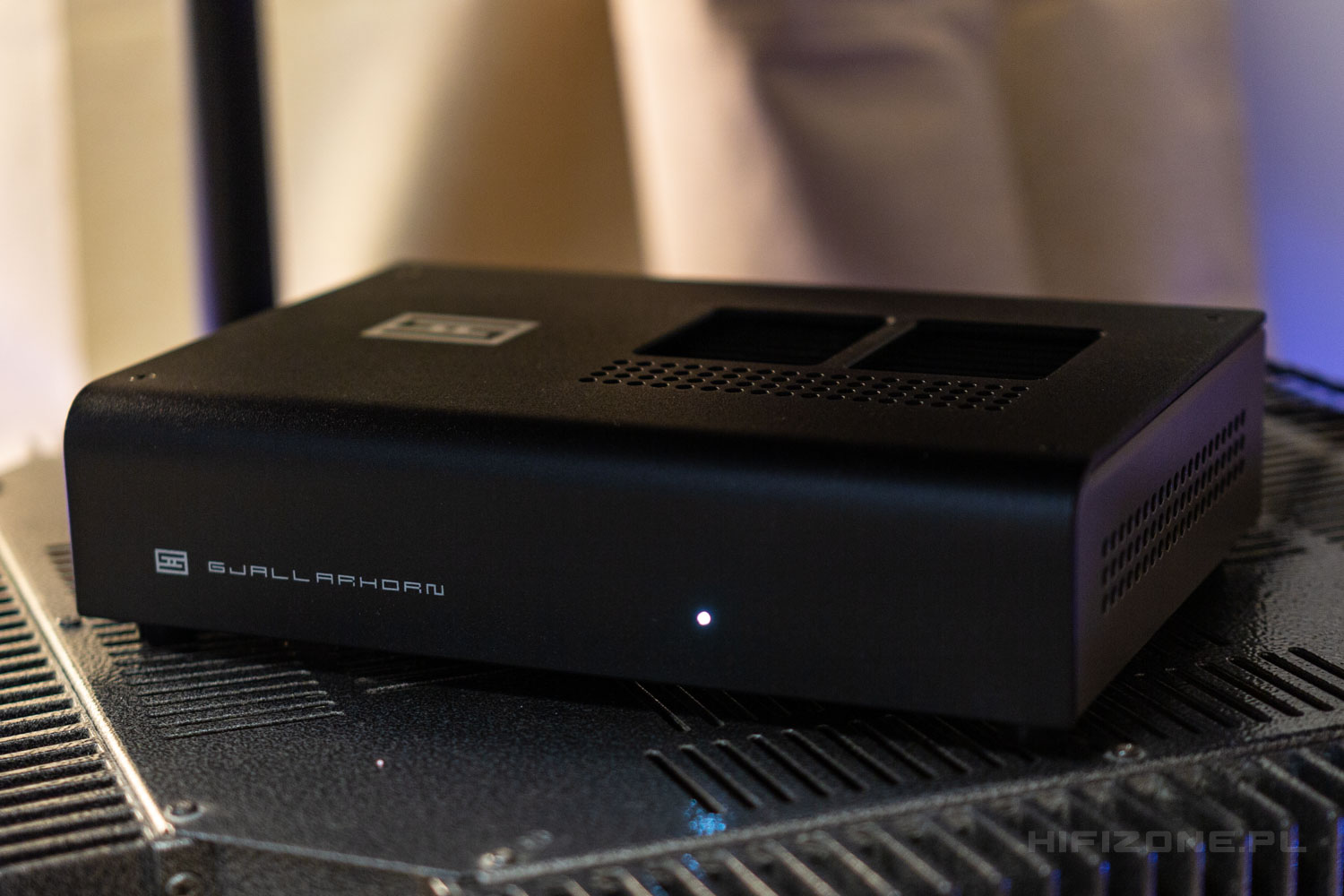
Last but not least, the higher end of the spectrum deserves another praise. It can feel a tad too enthusiastic at first, but the more you listen to it, the more you realize that it not only helps with the space recreation, but is also important in differentiating tracks and albums. And also distinguishes Schiit’s “linear” Class AB (with their Continuity) approach from many other amplifiers – but more on that below.
Gjallarhorn – summing up
In the good old days of hi-fi here there was a test called “the remote test”. Though it was mostly used for digital sources (namely CD Players and first generations of D-A converters) it could speak volumes about the whole audio system sonic prowess. The test was actually simple: you put an album that you actually liked, pressed a “Play” button and then listened. If there was something in the sound that made you want to skip the track (I remind: on the music that you liked) – then there was something wrong. This simple assessment was actually quite telling and often was a deciding factor.
Now please take a look at what I wrote in the first paragraph of the sound description. Gjallarhorn made me actually interested in the music that it played. This is one thing. The other one, listening to various tracks and albums – I always had that profound feeling that the amplification is done the right way. That I am not listening to amplifier that was designed by chance. But rather by someone who really has some idea of the intricate workings of different topologies and has some serious portfolio.
I would see Gjallarhorn in both well thought-out desktop or a nearfield system, where there’s a need for transparency and true-to-life timbre. In this scenario there will be a vast headroom margin when used with any speakers that offer sensible sensitivity. Really, for desktop, those 10W per channel at 8 ohms impedance – is plenty. As for using the Gjallarhorn for your main audio system – this is where things are actually more interesting. And require a little bit of explanation. The point is that in such a case the advantages of this Schiit (pun intended!) will likely be even more obvious, yet – if you take into account that speaker efficiency is the key here – its limits are far less likely to show up. Because at the end of the day it’s true: it those first watts that are of most importance is most situations. And the Gjallarhorn not only excels here, but also – possibly thanks to its Continuity power stage – provides its stellar sonic signature in the whole power spectrum. I will emphasize this once again: don’t be fooled by its small form factor of modest power rating. It’s a serious piece of work. And most importantly, a power amps that has its heart at the right place.
Highly recommended.
Adam Kiryszewski
Price: 299 USD
Product website: https://www.schiit.com/products/gjallarhorn