
As for the technical side of things, let’s start with the PSU. This is what Jason Stoddard had to say, when I asked about it:
“I’d personally never use a switcher (switching supply) unless constrained by size, heat, or budget. And we have used switchers where they make sense—Modi, Modius, Fulla, Hel, and Syn all have small switchers in them, but not off-line (from AC switchers).
But I’d prefer to avoid them when I can. Why? Noise, inflexibility, and cost.
Noise first. Switchers will inject high frequency noise into, well, everything in the chassis. This HF noise is usually excused as “far outside the audio band,” but it can modulate with other clocks, or other switchers, and come down into the audio band. It also can destabilize sensitive analog circuits. Yes, it can be “dealt with” and “mitigate,” but I’d rather just not have to deal with it at all. Offline (from wall AC) switchers also can inject noise into the AC line, which could affect other components. Again, best not to deal with, at least in my opinion.
Inflexibility second. Switchers usually are unipolar or bipolar. That’s one or two voltage rails. It’s very common for our designs to have 4, 6, 7, or more regulated rails (Gjallarhorn has 4, Vidar 7, etc). This is fairly easy to do with linear supplies. With switchers, you’re looking at a custom design, or a lot of different switchers.
Finally, price. We manufacture in the US, which means we are at an extreme price disadvantage when it comes to switching supplies. Prices for the same components aren’t the same around the world, unfortunately.
When people push me on Class D and switchers, I usually ask if their preamp is a Class D, switching variety. Especially if it’s a phono preamp.”
Makes sense and all of the above is hard to argue with. But what’s most interesting – at least in my opinion – in the Gjallarhorn, engineering-wise, is definitely the output stage. It has that unique implementation of it, which is called Continuity. When you listen to the Jason’s explanation of it – you can get some notion why such a name:
“Class A sounds great, and it’s hard to beat if you don’t have cost, space, and heat limitations. Class AB can also sound really good, especially if it’s within its Class A bias limit. The problem is when it transitions to Class B, the transconductance halves. This causes a discontinuity in the output transfer function that Bob Cordell has called “transconductance doubling” and John Broskie of Tubecad.com has also written about. Both Bob and John have come up with their own ways of mitigating this problem, and we’ve done so as well. Our trick is bringing in another set of output transistors to compensate for the droop outside of the Class A window of operation. It adds complexity, but it also allows us to tune the sound of the amp (we can increase transconductance, rather than simply compensating for it).”
Then there’s the current-feedback topology, on which Jason elaborates as follows:
“Current feedback isn’t usually seen in power amps, and I’m not entirely sure why. It may be due to numbers-chasing. It’s easier to get a voltage feedback amp to measure well in terms of steady-state sine waves, and it has better power supply rejection, so they are typically quieter. But current feedback is far easier to compensate, has much better transient response, is faster and generally more stable—that’s why I use it as much as possible.”
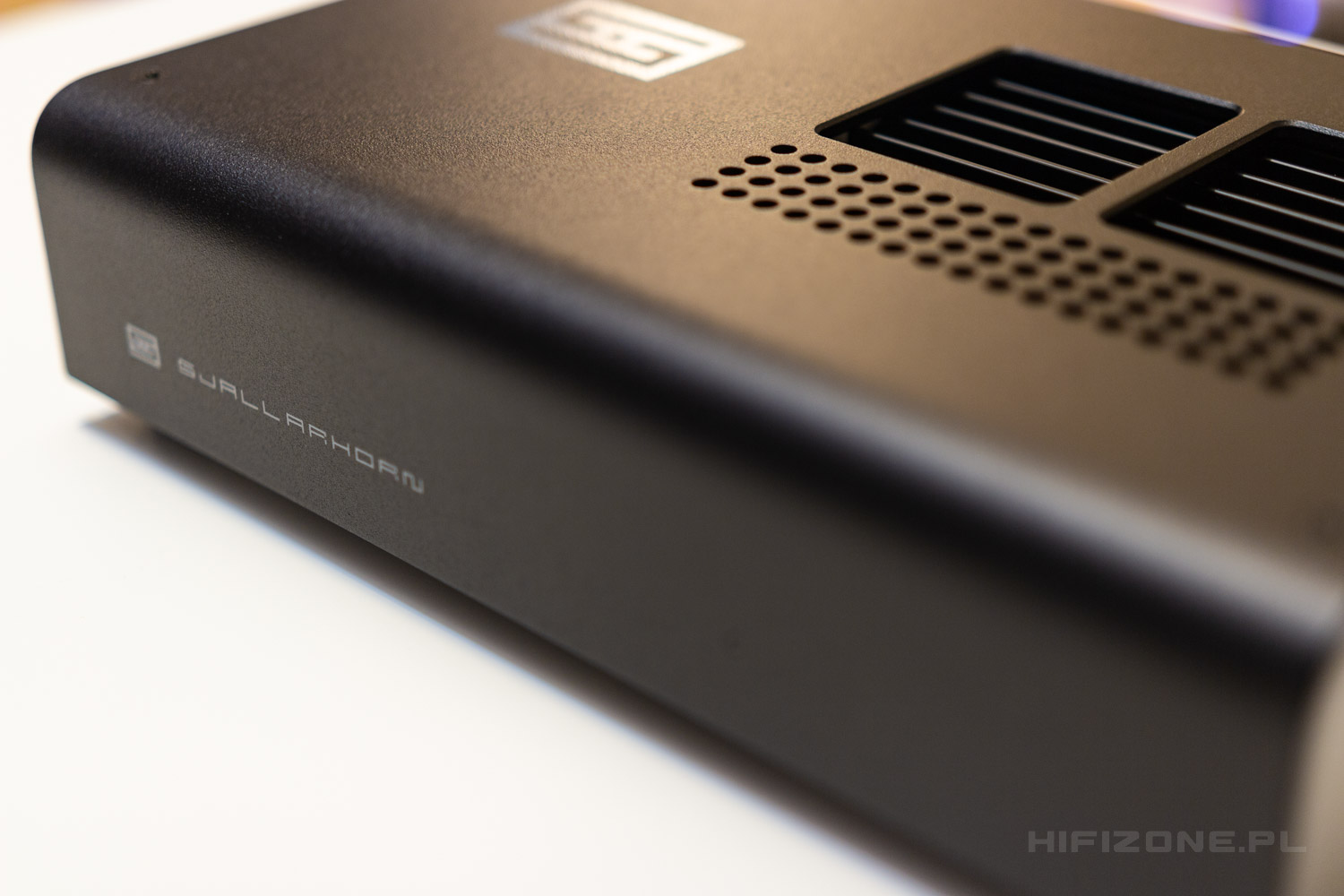
What I can add here, is the fact that at this price level – the current-feedback topology is almost non-existent. As are boosted power supply rails, which Jason explains as follows:
“Boost rails are a way to get higher efficiency out of an amplifier, by ensuring that you can run the output stage to clipping first. Most boost rails are stacked on top of the main rails. This means that the main rails will modulate the boost rails as the amplifier operates (more current “pulls down” the main rails, which pulls down the stacked boost rails. Our boost rails are independent of the main rails. This means it won’t modulate with higher loads, and provides a more stable operating point for the front end and voltage gain stages.”
So, as you can see – this one particular “Shiit” may be somehow classic in its design, yet there’s a still a lot of clever design choices under its hood. And, I will repeat myself for the second time here, it really can be viewed as a serious power amplifier for all those that just don’t need those three-figures power ratings. Moreover – the final conclusion of the technical and design side would be just one word: solid. It’s solid in its design, its hefty and it has some clever solutions that should translate into sound.