
Or some other products that seem to really bend the price-to-performance possibilities, at least on paper. Here, in this particular instance, I am referring to the Skoll phono preamplifier. Not to mention all those DACs that the company has made to date, many of them with the company’s custom digital filter and digital-to-analogue multibit conversion chips that most other companies deem too difficult to implement. Since they are not made for audio per se, but for more critical applications – like military or medical – instead. By the way, all of their DACs have their custom fully in-house designed implementation of the USB input called Unison. So, no usual XMOS or that kind of stuff here. They even recently made that thing called Urd, which is a CD transport with two USB inputs that you can then connect to the USB DAC of your choice. Nobody else does this kind of stuff.
I won’t even mention some really serious stuff like Vidar or Tyr power amplifiers. Or Yggdrasil DAC. Or Ragnarok integrated amplifier. Their time will surely come.
Going back to the Gjallarhorn: when you consider that this power amp retails for 299 USD, it makes even more appealing. As a matter of fact, yes, you can look at it as a somehow niche product. But Gjallarhorn is one of those power amps that may actually have much wider audience than the first glance at it might suggest. Please consider the following: in a real-world scenario, with real speakers (not some exotic planar ones, or those that are by their nature just terribly inefficient), and in a real space (not a 100 sq. meters) those 10W per channel will actually be plenty. Even when you have those stand-mounters with that 87 dB/2.83V efficiency, you would still probably be able to get a party volume levels with those in a normal condominium-sized living room. And when used as a pure desktop amp – those power ratings will actually allow for some headroom. So, we can assume that for the most people – at least in a well-conceived theory – it will be more than sufficient. So, the most important question here will be – how does it fare sonic-wise?

Schiit Gjallarhorn – few interesting design choices
If we put the modest power rating aside and take a look at what’s under the hood, we actually might get a little bit surprised. Because, against all modern trends – you won’t find Class D, nor the SMPS (Switching Mode Power Supply) here. Not at all. Schiit Gjallarhorn is a power amplifier with an output stage that not only works in a “linear” Class AB, but it even has that interesting thing called Continuity that allows it to behave more power stages in those in Class A amplifiers (more on that soon). In addition to that, it is fully discrete – so no op-amps here either – and has a linear, non-switching power supply with a quite bit toroidal power transformer.
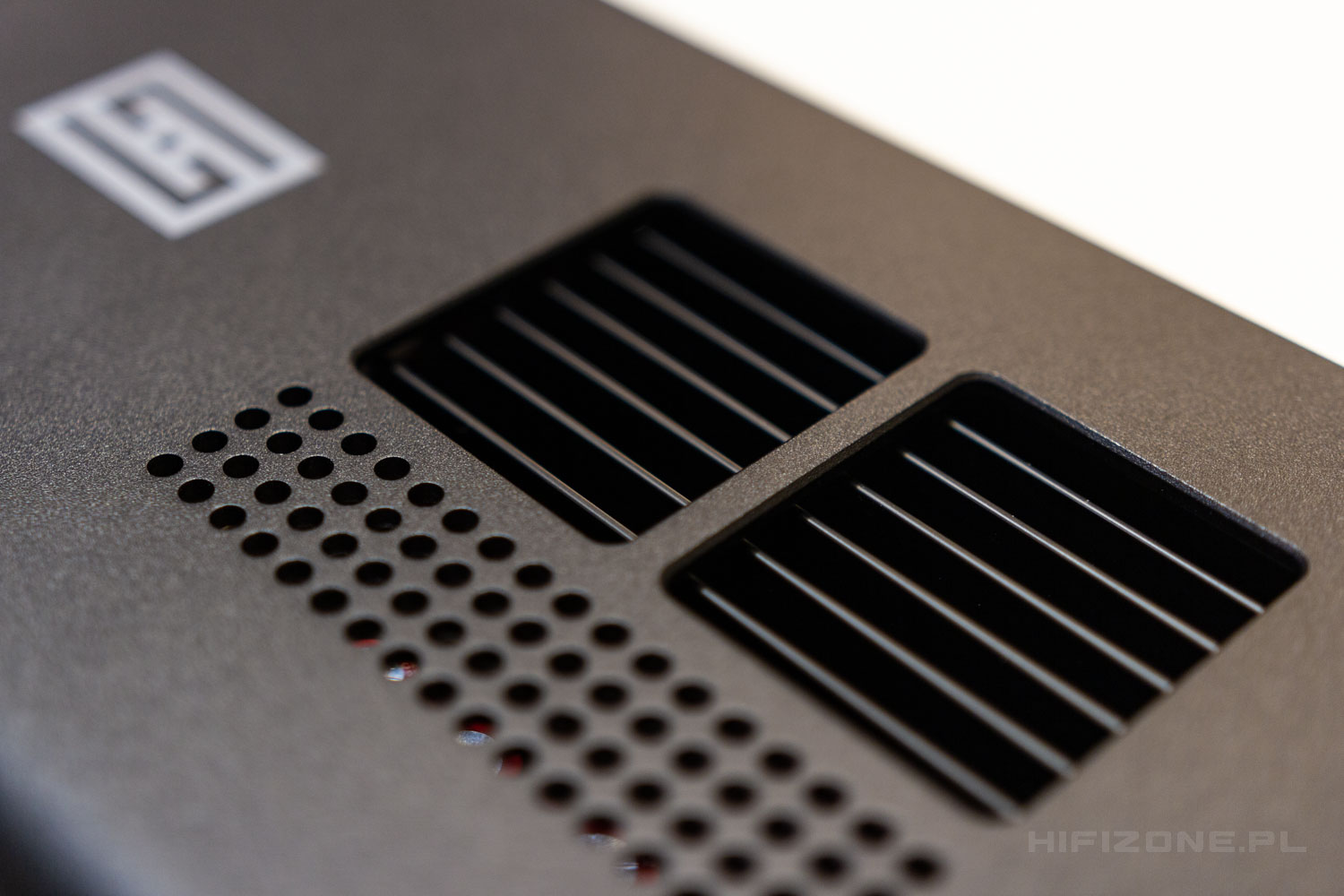
Funny thing: when I was getting Gjallarhorn out of the box, I wasn’t actually expecting the heftiness of it. I though “ah, just a desktop amp, I will pick it with one hand”. And then I felt those 8 lbs (which equals to 3.62 Kg) and my first impression was that I didn’t remember when was the last time that I had such a small thing for a review that was so heavy. And also – it was something more: I actually started to like it even before connecting it to the source and speakers. In a world where the Class D, SMPSes and all that stuff is so prevalent Gjallarhorn was like a blast from the past on the one hand, and return to normality on another.