
As for the choice of the digital filtering modes, I actually got an e-mail with a brief description of them:
“Bit Perfect (BP) applies no digital filtering. Sharp, natural tones, and fuller midrange.
GTO upsamples all input to 352.8/384kHz and offers minimal filtering. No pre-ringing, minimal post-ringing. Enhances sound detail and density in a track.
Standard provides balanced filtering with modest pre/post ringing. Fast roll off, reduces HF noise and sounds tighter and controlled as a result.
Minimum offers slow roll-off with minimal pre and post-ringing. “Warmer” sound, and is halfway between Standard and BP.”
And while I would mainly agree on the above, let me present you with some additional observations. Since in this particular case, those modes do actually sound a bit (noticeably) different and can be seen as a more that reasonable way to fine-tune the final sonic outcome. I believe that most people will find the “Standard” mode as the least interesting here, the “Minimum phase” variant as somehow safest choice, “Bit-Perfect” being the most interesting, while “GTO” being the mixed-bag. And while on tracks like “Head Boing Bang” by J.B.O. the “Standard” filter seemed the most controlled one, at the end of the day I always switched to “Bit-Perfect” or “Minimum” setting.
While the GO bar sounds, as I previously mentioned, full and even a bit on the analogue, laid-back side it also offers a generous soundstaging. On Natalie’s Merchant “The Peppery Man” the space was dense and was verging on the more expansive than intimate scale. This is just another aspect where the GO bar’s sound just plainly belies its small physical size. If you listen to Madonna’s “Vogue” you could easily be tricked into thinking that you’re actually listening to a desktop rig.
On Daft Punk’s almost legendary “Doin’ It Right” the lowest bass notes were delivered just like they should be. Obviously – dedicated bigger sources of amps will be better here, but what I heard on the HEDDphone with that small iFi’s dongle was much more than satisfying. It was actually good, and when I changed the phones to Sonorus VI or some IEMs – the punch that GO bar delivered was way above its price tag.
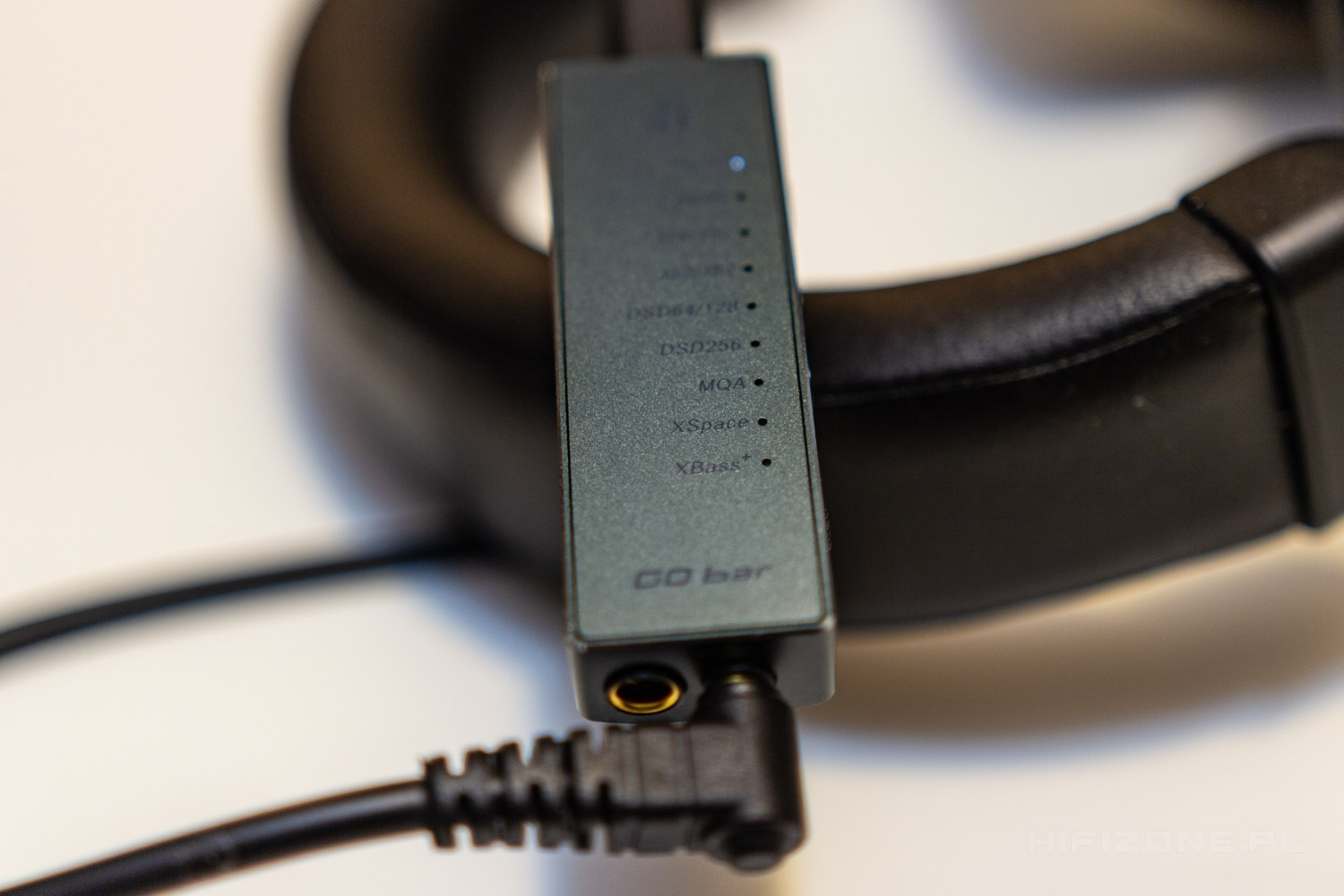
You may ask – whether are there any shortcomings sonic-wise? Well, if you consider both the size and the price of the GO bar – none. In the grand scheme of things it will usually boil down to preferences. But then here comes the digital filter choice possibility and the XBass and XSpace modes. Even leaving the latter out of the equation, simply going “Bit-Perfect” offers really unique sound.
And yes, there are of course other dongles on the marker. The closest one to the GO bar sonic prowess would definitely be the Questyle M15. Yet it won’t be as powerful not have such tweaking ability. Audioquest Dragonfly Cobalt will be close, but still not there yet.
As for the XBass and XSpace modes – especially the first one may be useful, but obviously your mileage may vary. It will boost lower and middle bass and make the sound generally warmer. The XSpace mode will somehow deepen the soundfield, but I feel that here it even more boils down to preferences.
iFi Audio GO bar – conclusion
First things first. As far as the dongles without battery that have actual size of the dongle – this one seems to be really the best overall. In other words: yes, if you want the best there is, irrespective of price, this is the one to get. But then there’s the other thing that shifts the whole context quite a bit. If you remove the physicality out of the equation and can power it properly – then it suddenly can take place of many bigger and heftier DAC/amps. Not only because it will be more powerful, but also because it will in many cases just sound better. And also provide more sound-tuning possibilities with the “Bit-Perfect” mode that comes to my mind here as the star of the show. Recommended without hesitation.
Adam Kiryszewski
Price: 329 GBP/EUR/USD
Product website: https://ifi-audio.com/products/go-bar/