
While most of them are self-explanatory, what I would like to point out here is the inclusion of Roon and AirPlay modes. Both of them work really well and for someone who’s using Roon on a daily basis and would like to use the M23 in the bigger main system as a source (which would mean a streamer and a DAC) – that may be a game changer. Another really important thing may be the FiiO screen cloning feature that will allow to control the whole player from the mobile device. What it does is basically cloning the DAP screen on another device, which then acts as a remote control. When you add to the mix the fact that it has dedicated “Desktop Mode” when the player runs entirely on external power (without draining nor loading the internal battery) – then the M23 may as well serve as a source for the bigger system that is even not a desktop one. What would be needed is an adaptor cable from 3.5 mm mini-jack to a pair of RCAs or from 4.4 mm Pentaconn to XLRs balanced one. And, obviously, a dedicated 5V PSU with USB output – in my case I used the iFi iPower with great results.

Going back to the software and processing side, we also have a feature well-known from other FiiO players (I believe that it was first introduced in M11 or somewhere in its time) called “All-to-DSD”. This feature – as the name suggests – resamples everything to DSD, providing the listener with a different sonic signature. It has also been optimized over the years, as FiiO states:
The M23’s ALL-TO-DSD specification is the same as the M11’s, all the way up to DSD64, but after several generations of iteration, the ALL-TO-DSD function on the M23 requires fewer resources, consumes less power, and is matched with a high-precision, low-jitter clock source that is provided for the entire audio system, resulting in a cleaner sound.
In addition to global “All-to-DSD” we also have a global PEQ, a parametric equalizer that can work with any source. There’s also a quite a lot of other things, like two-way Bluetooth (sending and receiving), a LED around the power button that informs about the sampling frequency. And there’s a fast charging too. Moreover, we have a 5.5 inch screen with 16:9 aspect ratio and 1440 x 720 resolution. The latter could be perhaps higher (it’s not HD), but that’s just me.
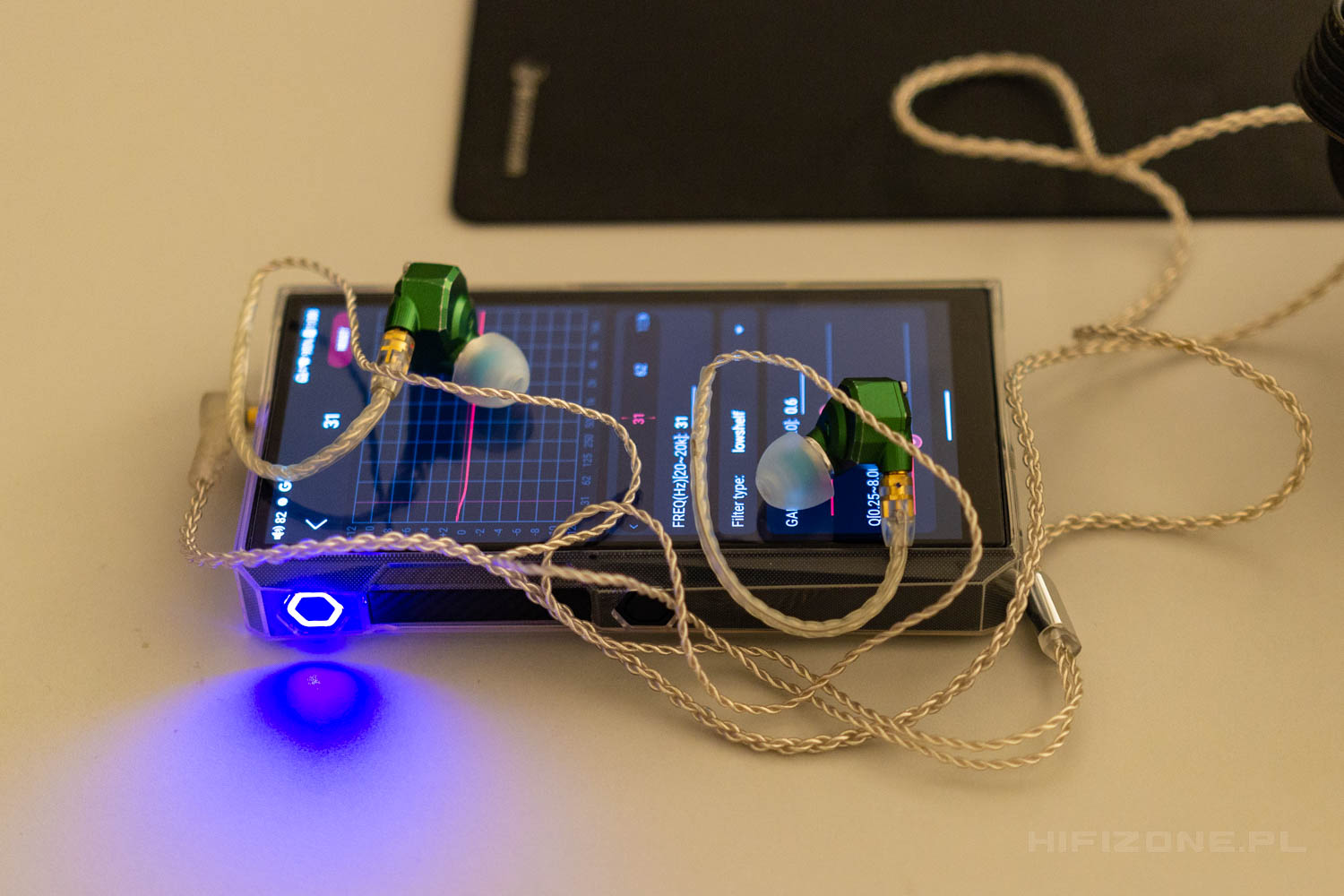
Before we embark to the sound description, let me comment on the general feeling and every-day usage of the M23. What is really heart-warming is how everything just works. The UI is responsive and the player just feels friendly to the user. You can easily feel that the company has come a long way from the days of the players like the first M11. Because everything that’s implemented – is implemented really well. This is also in regards to the screen cloning function and the Roon mode. Running time on battery will obviously depend on the usage scenario, but in my case it was fairly consistent with what the manufacturer declares. On IEMs it was something around 9 hours. One thing though – you really need to get this Power Delivery charger. Remember, it’s a 5500 mAh battery. Translucent case is included, and so is already attached screen protection foil – but this is one of the hallmarks of the company’s players.
FiiO M23 – the sound
This is where things get really interesting, because if you expected the typical AKM-velvet sound, you might be actually surprised by how it turns all those expectations and stereotypes on their heads, while providing something that will really make this player appeal to a wider audience. This is also one of those players that sound just right from the beginning and gradually grow on you the more you listen to them.