
The whole idea with this volume-and-sensitivity-related stuff is actually even more interesting, if look at it from this perspective: when you are listening at your desktop around 2 am in the night, when the background is usually really quiet – how much power do you actually need? With this – comes another, and this is more important than interesting, realization. Many of us live in rather loud environments without even noticing it, and we sometimes tend to crank up the volume to some level, where the harmonic (and IMD and all the others that I just won’t mention here) distortion of speakers’ drivers usually skyrockets. Noise background is one thing, but when listening for example, at night, you want you amplification chain to be able to do that 50mW-1W power range with clarity. You want it to convey subtle, small signals.
And this is definitely where the Rekkr excels. Because the first thing that you notice when you start listening to this Shchiit’s contraption is the clarity, subtlety and that very specific kind of delicacy to the sound. The general timbre is also very atmospheric, there’s a lot of high frequency information, those tiny clues that also translate to almost uncanny – for the price – spatiality of the sound. This is where Rekkrs qualities are light years ahead of any Class-D amplifier not even in that price range, but rather costing few times more. Since I wanted to check how well would Rekkr perform in real-life nearfield scenario at higher volumes I put it through all my favourite more, well, contemporary music. Starting with some film music – a soundtrack from “Tenet” by Ludwig Goransson to be precise.
On the opening piece, “Raining Day in Tallin” the sound was not only composed with the volume turned up, but it was also immense. Not only compared to the Rekkrs size, but rather in its ability to draw listener into the musical spectacle. What was also noticeable was the PRaT (pace, rhytm and timing) that was spot-on here. It was also that sense of immediacy, of being there, right in the middle of what was happening. For Rekkr also gives you something else – that directness, it may be diminutive in size, but what contrasts with that size is its sound being devoid of any curtains that are sometimes associated with many high-powered multi-output-transistor amplifiers.
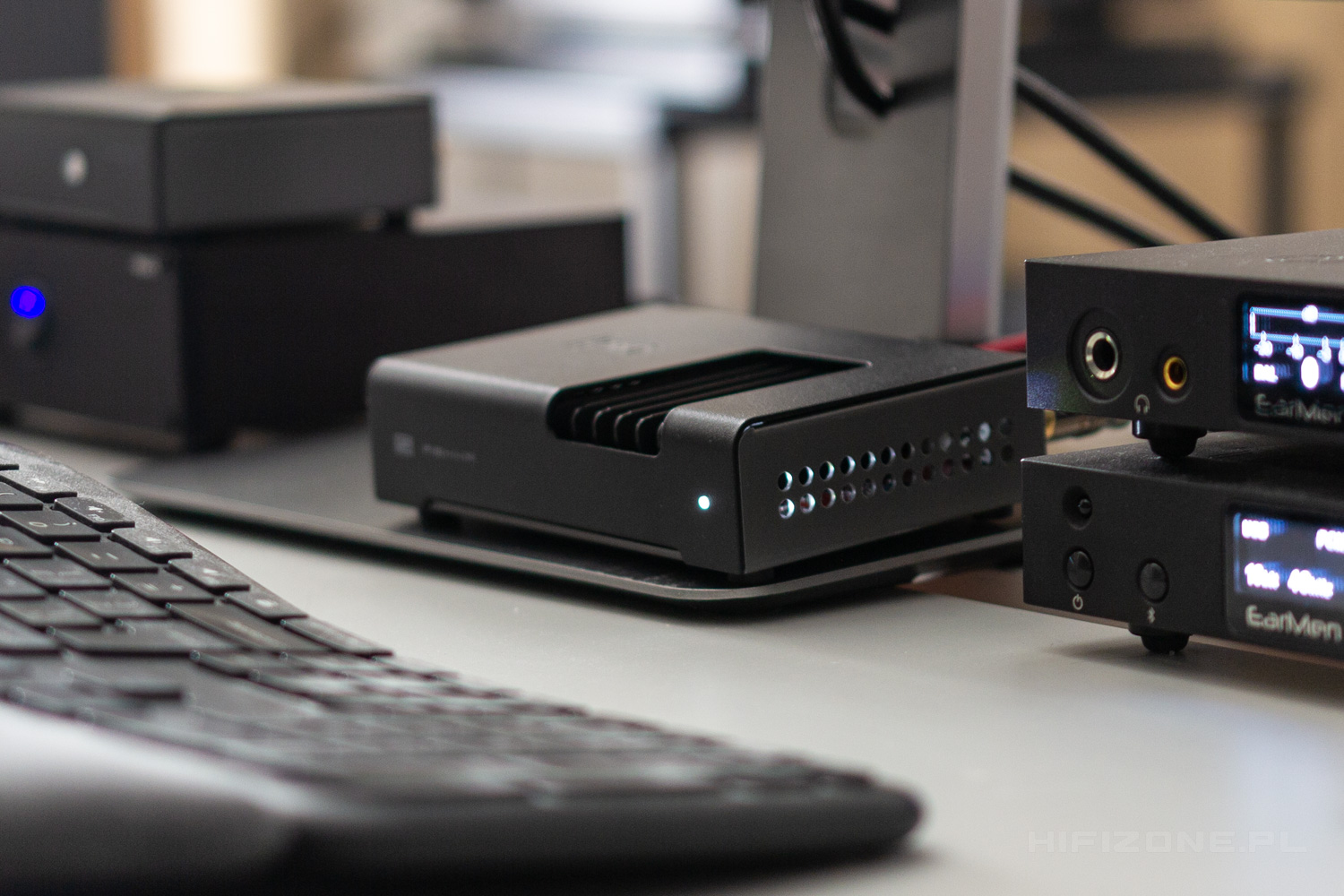
And the lower notes, those impulses that are so prevalent on this track – were there. Staying with film music for a while, I couldn’t help myself, but to check one track that I usually play to show show-off the abilities of the Seas L26ROY subwoofer driver that I have in my main system. It’s “Budgie” from the Hans Zimmer’s “Rush” movie soundtrack. This one particular track very often causes more problems, more additional strange “sounds” than the amount of the low frequency impulses that are actually recorded on it. And here, while the lowest registers were obviously attenuated below the AE’s port output, the higher as well as the middle bass harmonics were presented with clarity and were also quite rich and informative. The same track on my main system sporting 12” woofers – but still with the Rekkr – gave much more pronounced bass impulses. Still not what those big, heavy and hot power amps can produce, yet – it wasn’t like that there was something noticeably missing.
Staying with the “Rush” movie soundtrack for a while, on “Mount Fuji” what was – especially when you look at the Rekkr’s asking price – astounding, was the amount of emotional content. That ability to convey that subtle changes in timbre, harmonics translated here to rendering not only the objective sonic qualities, but also to communicate the emotional content of the music.
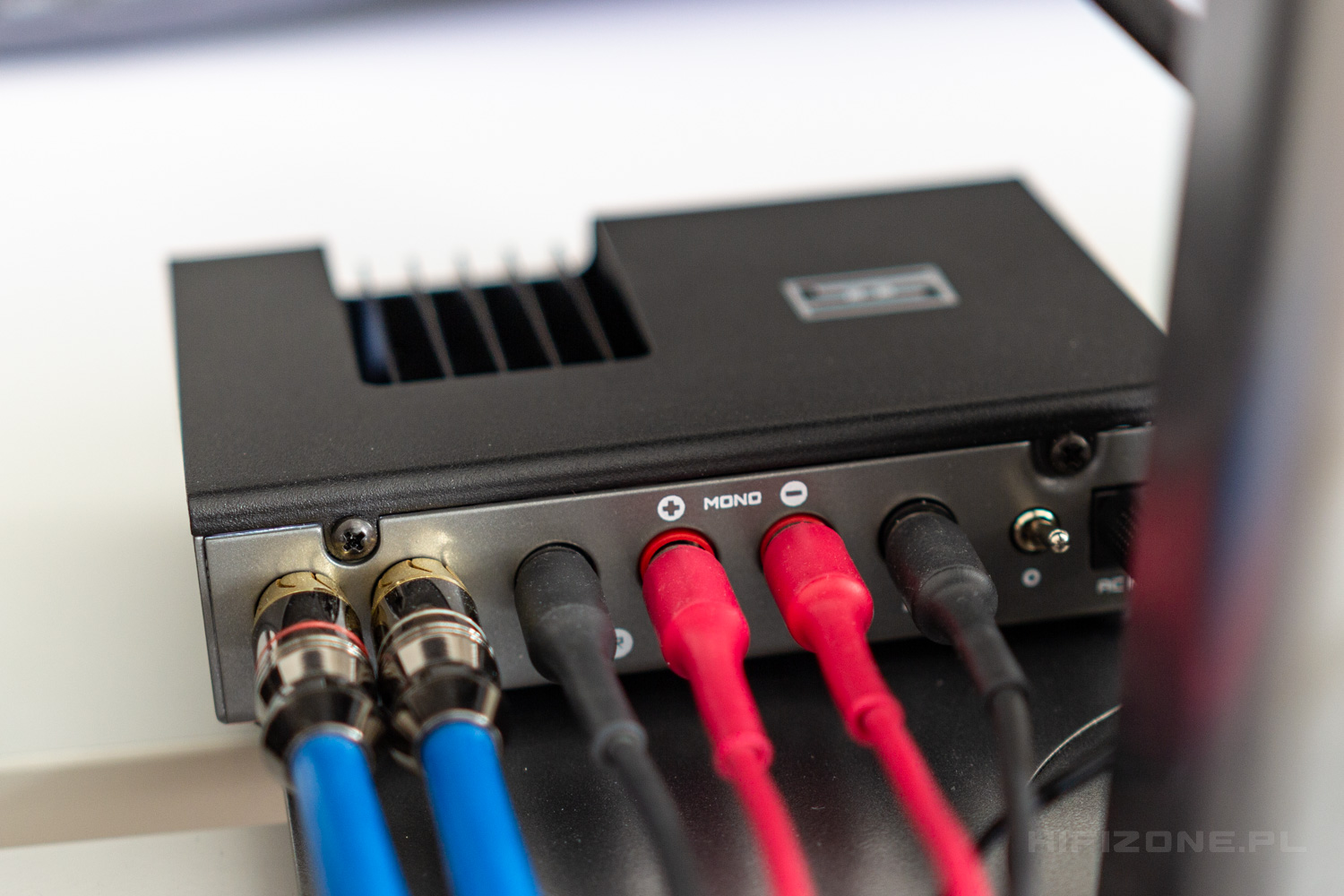
Encouraged by what I heard I moved to “Unusual” album by Marian Hill. Second track from it, “Differently” only proved Rekkr’s clean, crisp and direct quality. What should also be mentioned here was that – and please notice that we’re still talking the desktop setting with the not-that-crazy-expensive AE100v2 – the overall rendering of this track was actually one of the better ones that I’ve heard. There’s really something about that Rekkr’s midrange overall tonal quality. Not only about it’s clarity and lack of graininess, but there’s that completely natural ability to convey all those details that on bigger amps may sometimes seem blurred.
This is also why the space recreation, providing clues regarding the listening venues is another Rekkr’s forte. On “Mysterious Vanishing of Electra” by Anna von Hauswollf I had more of a feeling that I was listening to a down-sized version of a serious audio system, than to any desktop system that many might be so accustomed to. What was interesting was that the rendition of the Hauswollf voice was placed deeper in the soundstage, provided with all of the venue’s spatial contexts.