
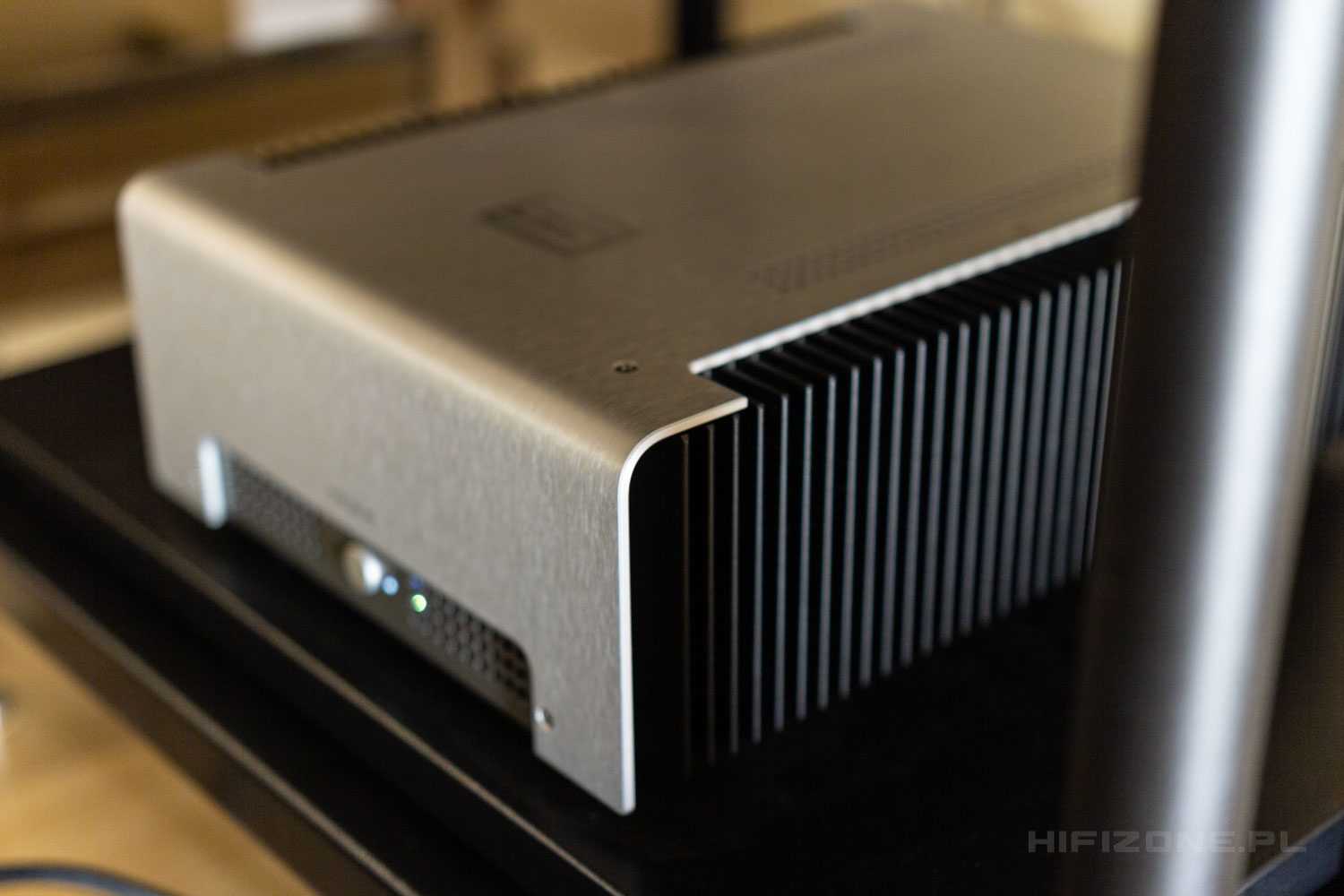
The other thing is that – despite sporting the newest Continuity variation – it still runs pretty hot. And the thermal protection mechanism is set pretty conservatively. That’s why you will need to provide a certain amount of ventilation, which actually translates to some space around it.
Schiit Aegir 2 – the sound
You know, once in a while there’s a piece of gear that comes to my place that not only leaves the lasting impression, but also can be described as “disruptive” in the bigger scope of things. I used this adjective already once in this review, when describing the Jason Stoddard’s and Mike Moffat’s company in the very beginning of this review. Yet this one-word description is so well fitting for the Aegir 2 also because I do believe that while all three of the Schiit power amps I had a chance to hear represent great value for money, the Aegir 2 is something just different.

Before we actually start describing the sound, let me give you some more context here. The first power amp from Schiit that I reviewed was the Gjallarhorn, followed by the Rekkr. The first one was “only” very good, and the second I would describe as surprising. I even started speculating on which would be better – two Gjallarhorns or one Aegir – in the e-mail conversation with Jason. Because you know, there are some situations in which the common (audio) knowledge works and some where it simply goes astray. Obviously, I had certain expectations regarding the Aegir 2 after what I’ve heard from its smaller and obviously cheaper (and lower-powered too) siblings.
This is one thing. The other is, when you move up the ladder it’s usually incremental gains in sound quality that usually more or less (usually less, let’s be honest) reflect the upward change in price. This would usually also – bear in mind the word usually here – would mean that the cheaper offerings will offer better price-to-performance ratio. Or, plainly speaking, give you more bang for your buck. This can also be viewed as just another effect of what’s called a diminishing returns. Yet even if we consider this mechanism somewhat working, and especially true in relation to audio components, we also need to consider that there are exceptions. In other words that on this price-vs-performance curve there are local singularities that make things even more interesting.
When connecting Aegir 2 to my main system I expected it to be good. I actually expected it to be better-than-I-expected after I heard two previous amps from the now Texan company. And the new Schiit actually surpassed all that I was thinking it would be. But before we get to the gist of the matter, let me give you one or maybe even more than one word of caution here. I would strongly advise against making any judgements or assumptions when this amp is cold. This is one of those amps that just morph from sounding plainly bad when just powered on to sounding good after half an hour and awesome after twice that amount time. I really want to emphasize that, since while it’s generally well-known that all those Class-A or single-ended (by that I mean solid-state or hybrid single-ended, which by the way will also be Class A because SE operation entails that) amplifiers and power amplifiers require just some time to reach their full sonic potential, but in the case of Aegir 2 – it’s a gradual improvement over the first one hour, which is even more palpable than in many transistor push-pull Class A designs. And after that first hour – you will still hear some improvement with time. Aegir 2 actually hold the first place in my private ranking of the difference in the sound when cold vs when fully warmed up. I may only be guessing that this is due to the fact that is uses both NPN and PNP transistors on both rails, but that’s just my loud thinking.
Anyway, how does the Aegir 2 sounds? Let’s imagine an equilateral triangle here. As you may know – that triangle will have apexes. Let’s assume for a second that each of those apexes represents one group of amplifiers in general, be it power amps or integrated. On the apex one we will have the so called “high-resolution” solid state power amplifiers that usually have high bandwidth, low distortion, high power and can drive almost anything. They usually sound clean, transparent, but some would describe them as cold or maybe even boring. On the other apex we will have all those class A push-pull transistor and tube designs that will possibly have more saturated timbre, more lush character and maybe be less resolving, more leaning on the denser side of things. And on the last, third apex we will have those single-ended (usually tube or hybrid) designs, that, well, usually excel in micro-dynamics, have super-realistic timbre and can throw ethereal stereo images with ease. But also need sensitive speakers and require special care.