
As far as those Continuity goes, it seems to even have some variants, which Jason has for the first time differentiated on the famous Head-Fi thread where he explains the new gear and many other audio-related stuff. This is the simplified version for us:
- Standard “Classic” Continuity: used on Asgard 3 and on the original Aegir. Gives you about half the standing current of a typical Class A design for the same rated power. Has some inherent losses that mean it’s a bit of a power hog.
- Continuity S: used on Jotunheim. Works more as a power band-aid in a predominantly Class AB design. Allows for lower bias current. Does not have the NPN/PNP pairs running at the same time, though.
- Enhanced Continuity: Tyr and Aegir 2. In Tyr we figured out a way to reduce bias current a bit and retain the benefits of standard Continuity. That worked so well we used it in Aegir 2. It’s an NPN/PNP on both sides design…but it’s tuned so that the Class A-like effects occur only over about 90% of its total output, rather than 100% as in “Classic Continuity.” This enables much higher output power.
The thing that we should derive from the above explanation would be that we actually get those “class A-like” effects up to around 90% of the power envelope, which here is around 30WPC. This means that actually no matter how loud we listen – it should sound good at all power levels, because at those 90% of wattage it’s highly likely that we’ll be triggering the protection system anyway before reaching the last 10% of power.

And apart from the Continuity, there’s one thing that we need to cover here, before we embark on the sound description. And that is this thing called Halo. This one is actually tricky and at the same time very – and I mean very – technical. So, some of you may want to move on to the next chapter, while some may choose to stay with us just for a while, while we will – briefly – explain of what’s going on with Halo, and with speaker and headphone drivers in general. Because all those mentioned are inherently connected and one should be described in the context of another.
The first thing here is that (almost) every driver, be it a speaker or a headphone driver will – and this especially concerns those of dynamic nature, where there’s a coil in a magnetic gap that is responsible for getting the membrane moved – will exhibit something that is called back-EMF. EMF here stands for “Electro-Motive Force” and the word “back” here means that the speaker reacts to the signal it is fed by the amplifier by actually producing another signal that it sends back to the amp. Halo is basically a means, a circuitry to deal with this, which should lower the driver’s distortion. Schiit states that it’s a “mixed-mode” feedback technology:
Mixed-mode means that it uses feedback so it is not just a voltage-output amp (low impedance) or a curent-output amp (high impedance), but it is somewhere in-between. By doing sensing on the ground return, Halo can compensate for some driver excursions, especially those with large EMF. Or at least that’s our theory. It certainly appears to be doing something. And, in some cases, we’ve gotten improved acoustic measurements in the bass (typically around port resonance) when using Halo. But that doesn’t explain why it appears to do something with planar designs as well, which have ruler-flat impedance plots.
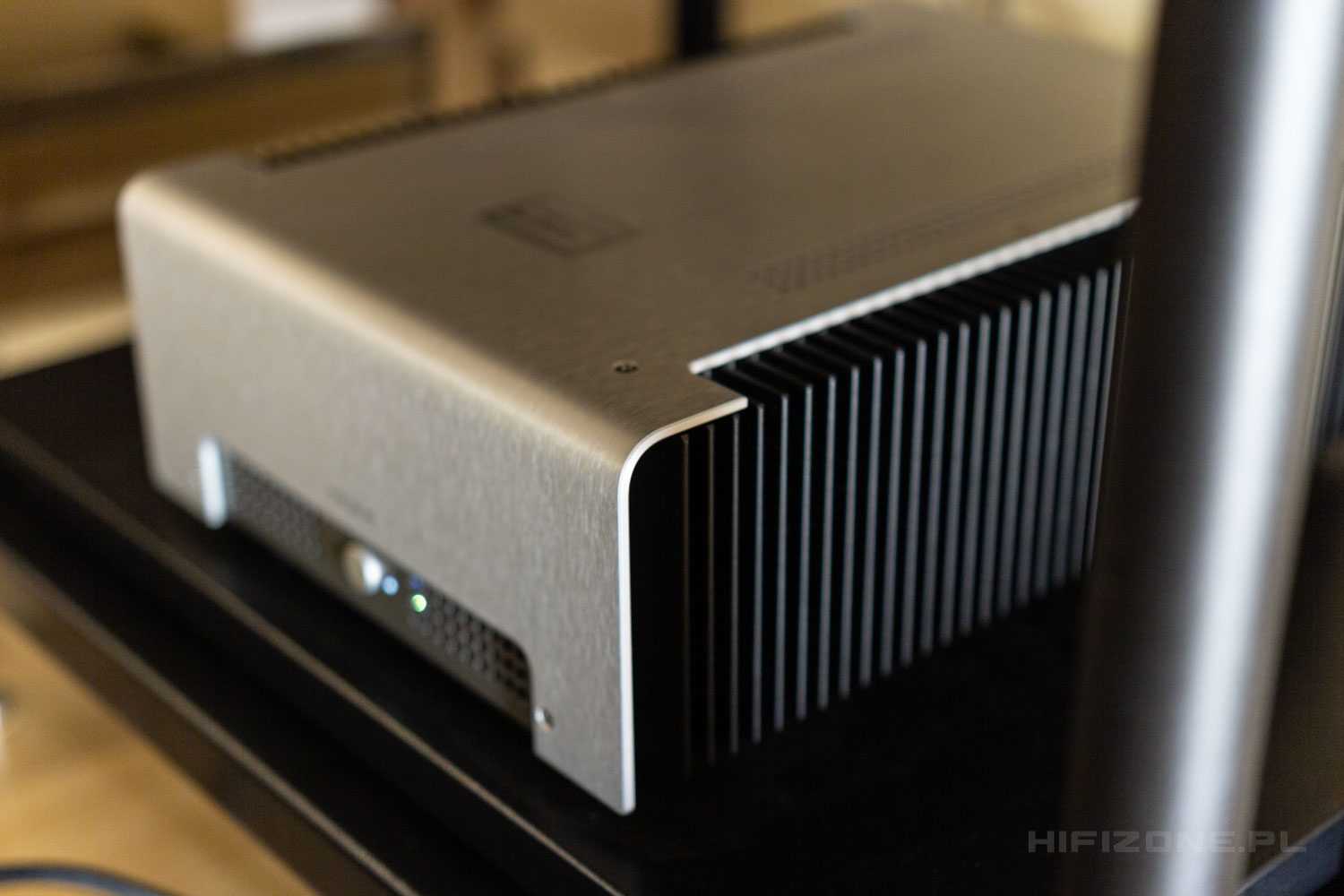
Whether the Halo works or not we will tackle later on, but the whole concept is interesting nonetheless and is also something not found in the power amp world of today. I actually know of no other power amp where it would be officially stated by its manufacturer that its feedback loop takes the back-EMF into account. Or even remotely acknowledges it. You can also understand Halo as a feedback loop that takes the speakers into account, but bear in mind that this is a bit over-simplified explanation.
As far as the technical matters go there are just two other things that needs to be mentioned. The first is that there’s a new standby system, which is de-biasing the output stage and needs around a minute to get it back on. There’s a power switch on the back and the standby button on the front – but you can use the latter one, since Aegir in standby mode uses around 1W of power.