
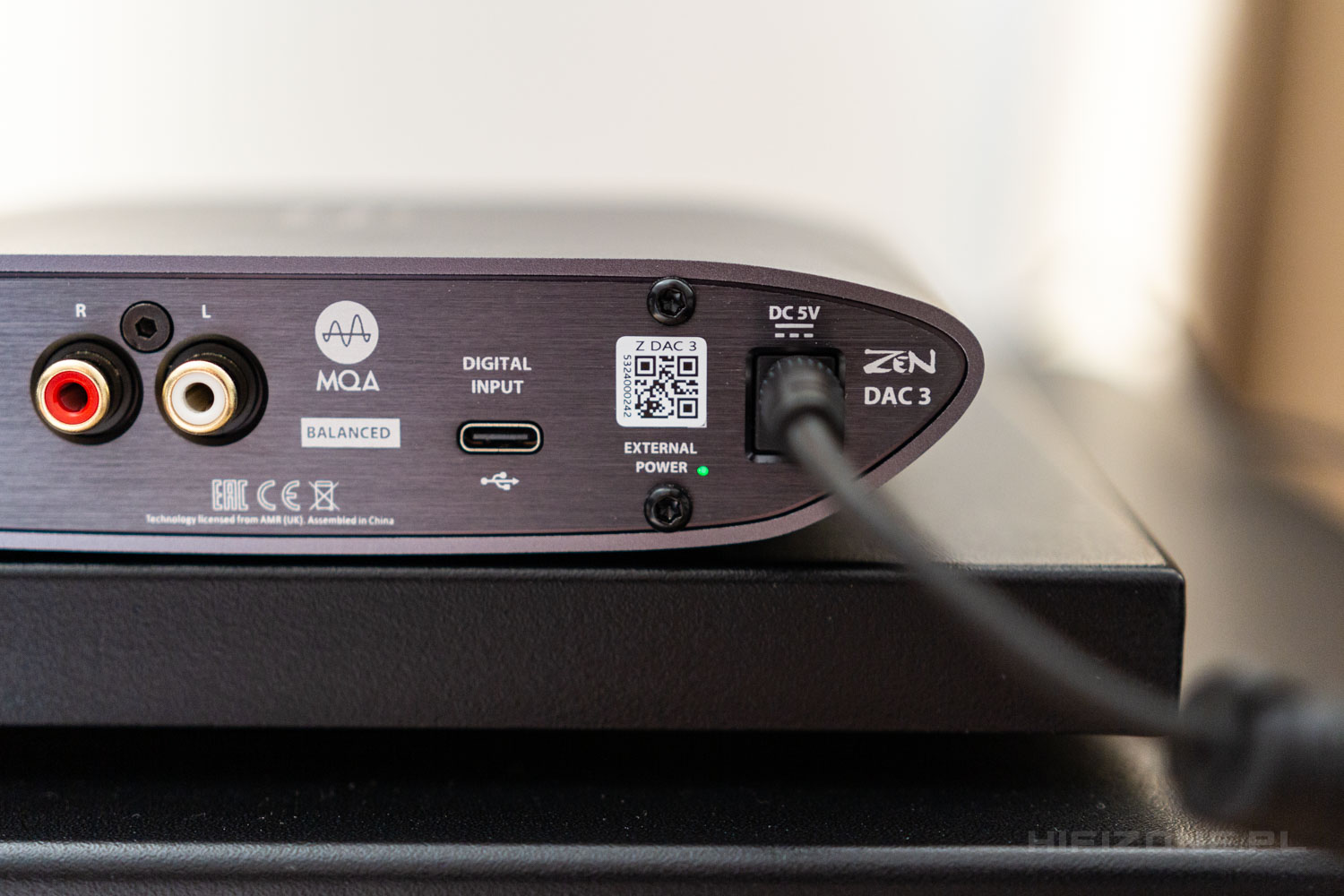
So, in this case that would be obvious that using an external power supply unit would be of obvious benefit to the noise levels in the whole unit, especially when using a PC as a transport, which will usually be the case.
And now, let’s get to the gist of the matter.
iFi Audio ZEN DAC 3 – the sound
I started my listening sessions of the ZEN DAC 3 not with any kind of your usual review music or playlist – but with a fast-paced music of a more electronic origin. Yet it soon became apparent that there’s definitely something about the fact that iFi Audio brags so much about their DAC chip of choice so much. There are two things that soon became apparent and easy to spot. The first one is the lush and at the same time unique tonality. And the other is something that is a bit harder to describe verbally, yet many people just call it musicality. It’s not that there’s one (or more) strictly technical trait that would stand out here. But rather the thing is that just after a few moments of listening to this DAC we come to a realization that the ZEN DAC 3 sonic recipe is simple and working at the same time. Because it’s having a more coherent and at the same time more musically complete approach than what we may got used to at or around this price point. What’s also interesting – and a really important and defining aspect of this particular converter – is the fact that it just makes a listener engaged into the music. This is one of those affordable DACs that simply do have the ability of swinging the attention from all the technicalities to what’s actually playing, to the repertoire and the musical performance itself.
It’s lush and smooth sounding, yet without compromising any of the things like transparency or precision too much. Those aspects are definitely there when required, yet it’s not something that the ZEN DAC 3 shows-off at a glance and all the time. Because it’s that tonality, smoothness – also meaning almost uncanny fluidity here – that even many more expensive converters often lack that is the main forte of the ZEN DAC 3 here. It was not only apparent on music like Sonic Adventure Project “Forty Two”, but also on the first album of the British musician, remixer and producer Nick Bracegirdle – who is better known as Chicane. The whole “Far From the Maddening Crowds” album had an uncanny and immersive quality to it while providing required in this case bass grunt and frequency extension at both ends of the spectrum. The way it presented “Offshore” with its lush soundscapes and the agility rendering swiftly morphing sounds was remarkable and really outside its price point. What I also mean by that is that it gets the listener’s attention not by strictly emphasizing any one particular aspect, but more – by the virtue of coherent and lush presentation – with the beauty of music instead.
Yet it still retains all the qualities of a modern digital source that – given its lush and fluid nature – may be quite surprising here. While it’s not any kind of “in-your-face” or laser-etched kind of sound, it also doesn’t give in too much when required. Let me also put it that way: it may be not the last word in sheer transparency nor soundstage width, its presentation is so coherent and involving that you simply don’t care that much. There’s definitely something different in the way those TI converter chips render the sound. What I mean by that is especially the ratio of leading to trailing edges to the whole musical fabric.

Listening to my more or less usual suspects with the ZEN DAC 3 connected to the big “speaker” system revealed that it’s actually better at recreating space and the atmosphere of the recording venue that I previously thought. You see, most people will put the ZEN DAC 3 on the desktop and connect it to the similarly priced headphones and also possibly use it with some active near-field monitoring speakers that, well, may be not the last word in spatiality. In both of these cases, when it comes to the recreation, the ZEN DAC 3 will not be the limiting factor here. On Vanessa Daou’s “Zipless” album, and especially on “Sunday Afternoon” and “Autumn Perspective” the British converter provided an engrossing experience of the singer’s voice being placed in a palpable and realistic environment. On Pernille Rosendahl “Feet On The Ground” everything was there: the ambience, the smooth yet clear voice as well as the good bass punch.