
Divaldi AMP-05 SE – the sound
Let me refer here to what I wrote earlier about a certain kind of audio gear that may be diminutive in size yet can be really surprising sonically. I will also allow myself to elaborate on this in a slightly different context. You see, there are situations that you need more time to get to know a certain device, to assess how it sounds. However, those best or the most – if you prefer – outstanding devices immediately draw attention to themselves. Of course, there are many quite important aspects to this, like the synergy with other equipment in the signal chain, warming up and generally reaching the right temperature (there are devices that, for example, play not so good when cold and after an hour or so change beyond recognition).
In the case of the flagship Divaldi headphone amplifier we don’t have such dilemmas. This one particular amplifier almost instantly from power on – plays music. After some time, be it just a few quarters of an hour, it plays even better. But what’s more important is something different here. It’s one of those devices that if we would judge it through the prism of the price, functionality or size alone, then it will look not so good. But when you actually listen to it, then it will suddenly turn out that there’s a new hidden variable that completely changes the equation. What makes the AMP-05 stand out almost immediately is the timbre and speed. We get a really lush saturation, you can feel that there’s a lot of going on in the soundstage, there’s also a lot of music. Yet there’s nothing lost at the same time, the amplifier makes a firm impression that it has a full and total control over how it conveys the music. And this is practically irrespective of headphones connected and the repertoire.
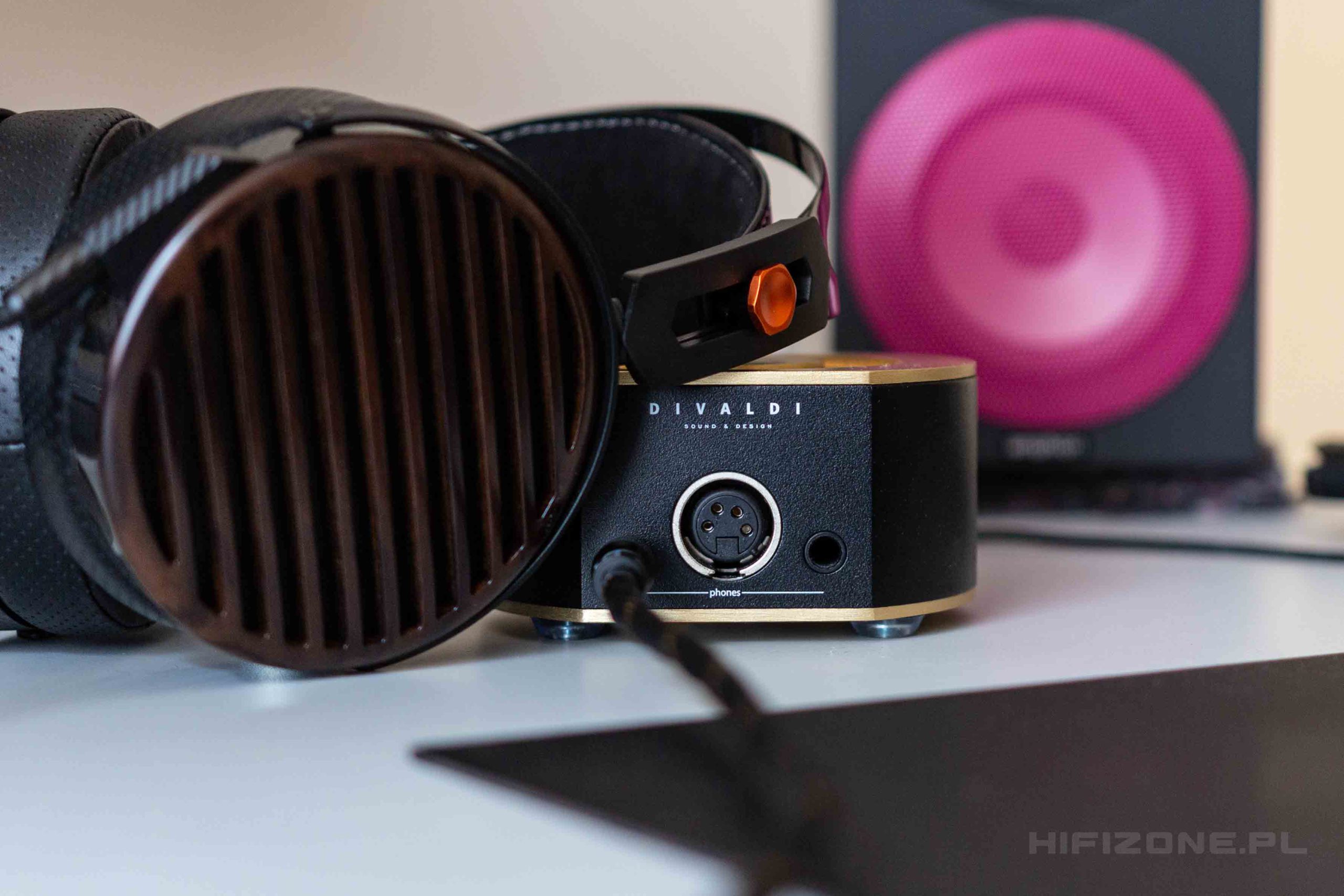
And while we’re at this repertoire, I started my listening sessions from the “Leave Your Sleep” album by Natalie Merchant. And to not make it too easy for the amp, the first headphones that I connected to it were the HEDD Audio HEEDphone TWO. And I mean the first versions of the “TWO”, not a GT variant that may be somehow easier on the ear, but at the same time not as direct as the first version. Let me a side not here. If you go back to the technical description, the designer mentions the “working regime” of the amplifier. I would like to elaborate on that, since while such aspects as timbre saturation or soundstage layering may be somehow important here, there’s something much more interesting. Well, you can hear in this sound, and I can draw a comparison to some “speaker” amplifiers here, that there’s a lack of a certain king of distortion. This often happens with solid-state equipment, less often with the devices that use tubes, yet it shows itself as something very peculiar. It usually manifests itself as a very odd sharpening of the sound, especially when things get more congested, when there are dynamic swings and lot is happening on the soundstage. It can be easily heard on headphones and loudspeakers that have very fast drivers, which can convey impulses with blazing speed. That’s why the headphones with AMT drivers can be a good magnifying lens for such additions to the sound and can easily show with what kind of electronics are we dealing with.
Coming back to the music and Merchant’s album, the “Peppery Men” soundtrack sounded really amazing. So good in fact, that I decided to leave my usual review playlist that would show how the amplifier deals with this and that and I plainly started… listening to the music. This is where I could theoretically end this review and give this particular piece of gear a recommendation. However in this case it’s really worth it to dig much deeper. The “Great Expectation” album by Tasmin Arched clearly showed that the AMP-05 SE has no problems whatsoever with louder playing nor with driving cans like HEDDPhones or HE-1000. It has a natural ease and enthusiasm instead. We could argue that this expression is too widely used in reviews, but the term “musicality” comes to mind here. But it’s not only about that. There’s an uncanny level of energy in the sound. The ability to convey – as it turned out on the “Sleeping Satellite” – the immense emotional factor in the recording was simply uncanny.