
Auris Audio Blues – the design
While the design of this turntable may be seen as a classical example of the good old engineering school of turntable design, when we look closer, there are details that will clearly indicate us that the team at Auris took some time when conceiving this particular turntable. Let’s start with the support system, so those elements that are in direct contact with the surface that the turntable is placed on. Let’s start with the fact that this is where we can find the first clever design decision. In Auris Audio Blues we have not four, but three points of contact – or more plainly speaking, feet – instead of four. As Miki Trosic from Auris Audio explains this:
The 3-point support is the most stable setup, and having fewer contact points with the surface reduces the transmission of vibrations better than 4-point supports.
Moreover, these feet are, as – again – Miki Trosic tell us – designed in-house and are “injected from mold”. This, in the case of a gear such as a turntable that will be inherently susceptible to the vibrations from the surface is really important. As is the ability of the support mechanism to provide a stable placement with as little energy transmission – or as much isolation, if we look at this from the other perspective – as possible. Here, in Blues we have both of those aspects provided. And we also have the height adjustment capability that makes getting the perfectly horizontal position not only possible, but also actually quite easy (since the three points of contact really is much easier to adjust than four).
The next aspect that is worth mentioning is that Blues uses an AC synchronous motor. This is actually the same unit that is used in their Jazz and Classica turntables. Why AC motor? This is how Miki explains this to us:
An AC synchronous motor has a stable RPM because it is controlled by the frequency of the electrical power, which is stable at 50Hz in Europe and other parts of the world, and 60Hz in the USA and Canada.
The same motors are used by world leaders in turntable manufacturing.
It’s also worth noting that as it goes for the motor power supply – the Blues is really interestingly upgradeable here. I wrote interestingly, because this is one of not so many turntables that are actually affordable and at the same time can be upgraded with a dedicated power supply that is actually of an advanced and really well conceived nature. What I mean here is that EON power supply that I mentioned earlier which sports that DDS (Direct Digital Synthesis) system for generating a very stable and as-close-as-realistically-possible to the exact specifications sine wave(s).
What’s interesting and worth mentioning here is that the Direct Digital Synthesis is not that often found even in the expensive audio gear and many years ago was used by Mark Levinson as a clock-generating mechanism in one of their “CD processors” that were strictly hi-end targeted (and also both very expensive and also very good sounding). Yet here we have the ability to upgrade the Blues with such an elaborate tech. We can upgrade the Blues with a metal sub-platter too, which is also not that often found especially in the area of more accessible turntables.
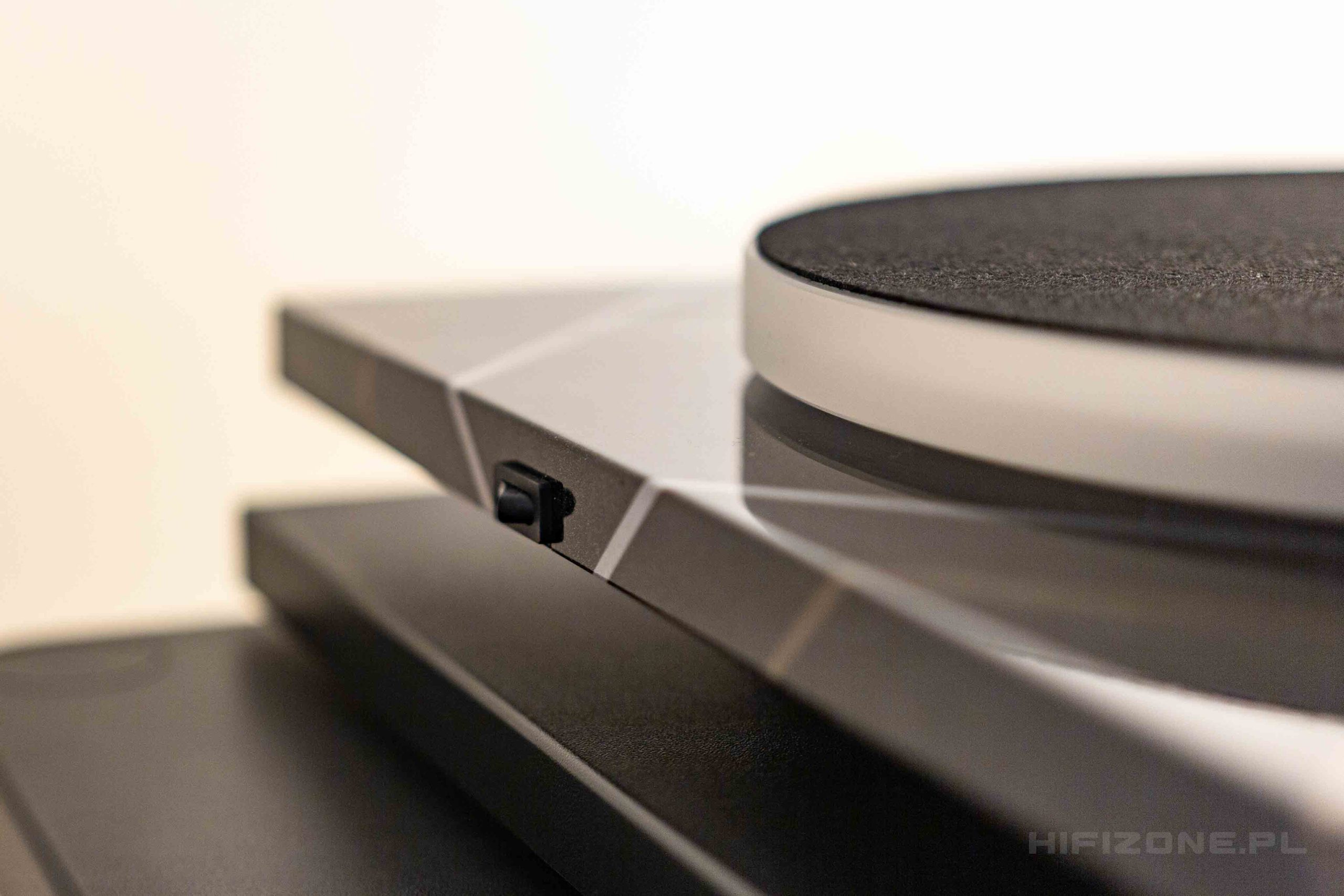
While the plinth may be actually seen as the least interesting part here, since it’s mostly in-line with what we can find at this price range (it’s probably wooden, the manufacturer does not actually state what material it’s from), the actual styling of the Blues is interesting. I got the – plainly speaking – lest classic version that actually looks better in real-life than on the photos.
The platter is acrylic and the platter bearing has a bronze main hub and ceraming bearing ball. Such combination, according to Auris, should provide a long service life. The effective tonearm mass is 11.7 grams, so that would make achieving the sweet-spot turntable-cartridge resonance quite easy.