
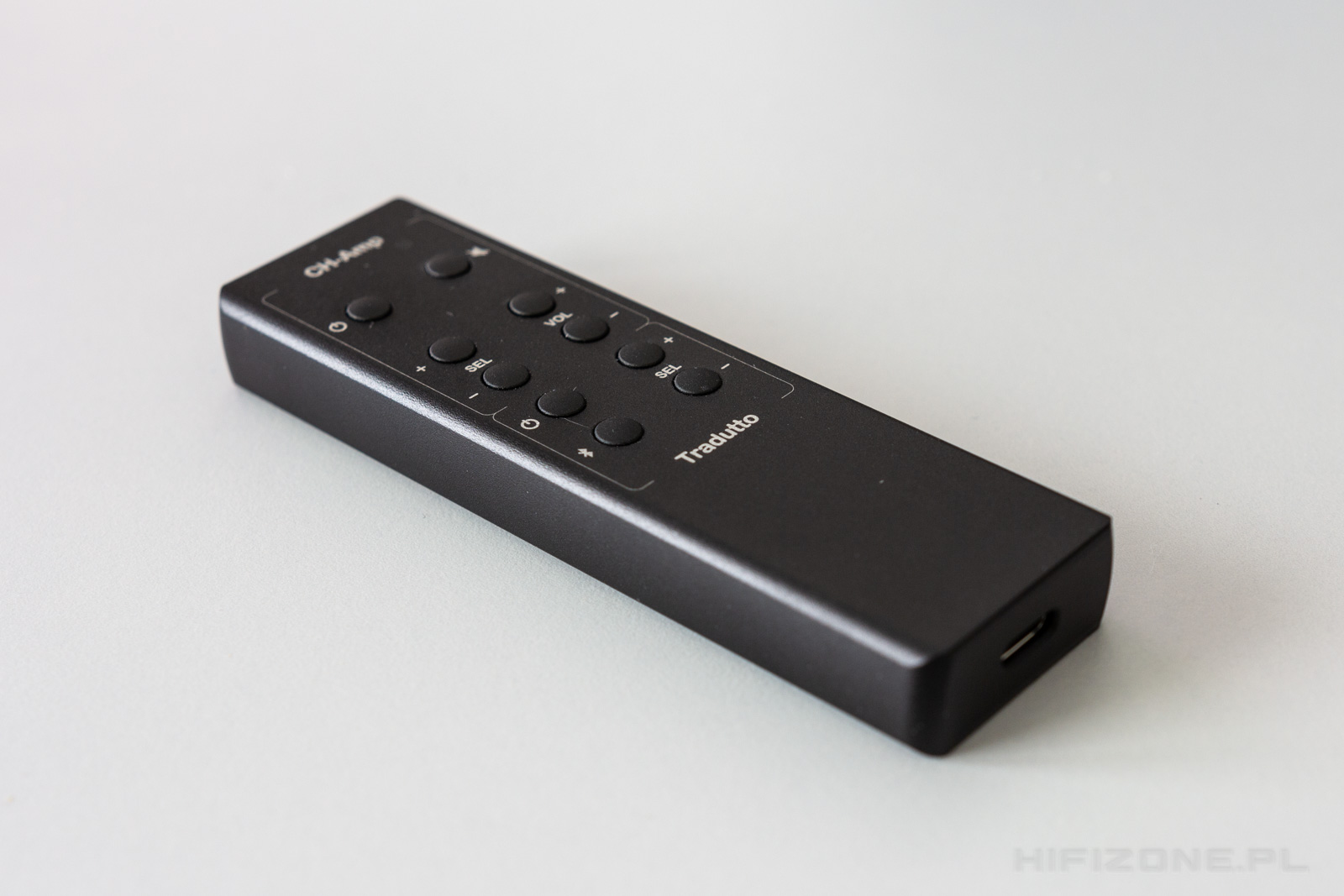
It’s the fact that you can charge it via USB. No more looking everywhere for that watch-specific small batteries, or that “smaller than AA, but I forgot the actual designation” batteries. The remote control that comes with the CH-Amp even has a small LED that will inform when the battery inside it needs to be charged (red led blinking) and when the charge is complete (red light disappears). As well as omission of including a remote control can very often be a show-stopper for some, it’s that small, thoughtful additions that together with other details make the whole difference. And add up to what – not always, not even often, but in some significant cases – mean more than the sum of its parts.
So here we are at the last, and the most important part of the CH-Amp two box-setup: the sleek-looking main unit. It follows the minimalistic concept, having on its front fascia only what’s actually needed and what follows its purpose. We’ll find both the 6.35 mm unbalanced output here, as well as 4.4 mm balanced headphone out. And an OLED display flanked by two switches, IR sensor and a push-dial. The display is interesting itself, since – apart from informing about the selected input, volume and gain level – it also shows off with a VU-meter. What’s even more interesting is the fact that this is not an input signal VU-meter, it monitors the total amp output instead. The slightly blue-ish shade of the display illumination goes very well with the overall styling and black painted enclosures of the whole EarMen setup. And doesn’t distract when the amp is placed, for example, close to a computer screen.
What also warrants a separate attention is the back side of the main unit, especially the connections. Since the CH-Amp is – as I mentioned before – a fully balanced unit, and a preamplifier too – it has a balanced line inputs and outputs as well. As for the former sets of connections, apart from the two RCA unbalanced line inputs, you’ll find also a balanced input. That particular connection is however, in part due to the size constraints of the unit, not based on the usual XLR sockets as you might expect – but on a single, 4.4 mm Pentaconn connection socket. The same applies to the balanced output of the CH-Amp – in addition to one set of RCA unbalanced outputs, we’ll find the 4.4 mm connection as well. I would like to stop here for a while and delve upon this, since this is one of the two things that may be polarizing for some. And, at the same time needs to be looked at from a somewhat broader perspective.

To begin with, the CH-Amp was devised to be (often) partnered with Tradutto DAC. The latter has a 4.4 mm balanced output, therefore such arrangement makes the connection simpler, and that is especially important when placing these unit on desk, where the last thing you actually want is the cable clutter behind the units. The other thing is that EarMen is not alone choosing to use the 4.4 Pentaconn connections for line input and output applications – just take a look at, for example, what iFi Audio is doing or at, also relatively new, Astell&Kern PA10. What I mean by this perhaps a bit off-topic example is that there’s a general tendency with some manufacturers to ditch the XLR connectors and opt for Pentaconn instead. And while some die-hard audiophiles may frown upon this, let’s make it clear that in case of smaller equipment and especially headphone systems – this is also reasonable choice.
The other thing requiring more elaborate comment is the something, which can be called a “safety mechanism”. In other words: when turning the amp back on, it will always start with the volume level turned to 0 and the balanced input selected by default. The same happens when disconnecting and connecting again anything to one of its two headphone outputs. This is to prevent some more delicate and sensitive headphones, especially IEMs from blowing-up by accident. And believe me, one can say that having to set the volume every time may be troublesome, but after I spend some time wondering whether or not did I blow any of the armature drivers in my Campfire Andromedas – I can wholeheartedly admit that more amps should behave that way. Definitely, someone at EarMen actually thought about the reality of every-day use and decided that even unpopular choices will be better in the longer run. Because they are actually better.
As for the power and gain situation: with the gain setting on “High” CH-Amp offers 11V at the 4.4 mm balanced output and 7V at unbalanced. This equals to, respectively, 3.8W and 1.5W at 32 ohms of impedance. This should be plenty in the real-world scenarios. And I assume that anyone with headphones requiring a significantly more power – will look elsewhere anyway. And quite possibly well above the CH-AMP’s price point.
EarMen CH-AMP – the setup
First things first, I listened to CH-Amp connected to various DACs, one of them being its sibling Tradutto, while the other ones were Mytek Brooklyn Bridge, SMSL D300 and Sonnet Morpheus. While both Tradutto and Bridge are ESS Sabre based, the SMSL uses ROHM chipset and the Morpheus has its own R2R architecture implementation. This variety allowed to confront the Serbian-made amplifier with completely different sonic signatures of the source.

I also used both balanced and unbalanced connections from the source to amp and from amp to headphones. As for the latter, I used not only HEDD Audio HEDDphone One, but also Fostex TH909, Final Sonorous VI, Campfire Audio Andromeda, Kinera Nanna Imperial and some older Etymotic IEMs. And additionally, a few other cans that were just also used for the sake of both comparison and getting the whole sonic picture of CH-AMP like cans from Dan Clark Audio or Etymotic single-armature IEMs.
EarMen CH-AMP – the sound
The first thing that makes itself obvious just after a few moments with the EarMen CH-Amp is how clear and uncluttered it sounds. This is especially striking with both more complex mixes as well as energetic, dynamic music choices. I started my listening sessions unusually, with the old and well-known “Ray of Light” Madonna album. Listening to produced by William Orbit and Marius de Vries “Skin” immediately made it clear that even with the HEDD Audio HEDDPhone One the amp stands up to its role and never falters, providing both the dynamic expression and resolution in spades. Even when listening to some experimental electronic music with a lot of synthetically-generated sub-bass and in conjunction with the German AMT-powered cans this amplifier delivered, which speaks volumes about its power supply calibre and sonic composure in general.